
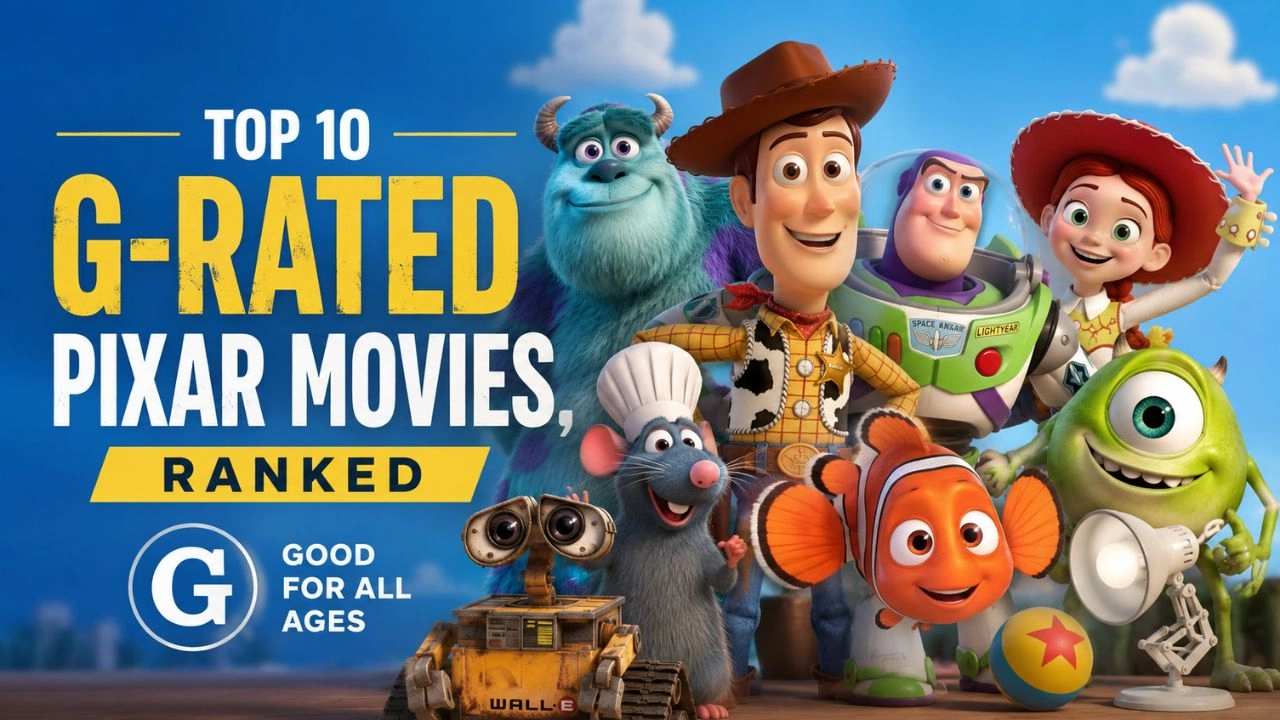
Pixar has released more than two dozen feature films, but only a small handful carry the MPA’s G rating — “General Audiences,” the board’s signal that a film contains nothing that would give any parent pause.
Once the default rating for animated family films, G has become increasingly rare in Hollywood, and even Pixar leans on PG far more often today than it did in its early years.
Of the 13 Pixar films that have earned a G rating, here are the 10 best, ranked by critical reception and what actually makes each one work as a truly all-ages watch.
The Top 10 G-Rated Pixar Movies
| Rank | Movie | Year | Critic Score |
|---|---|---|---|
| 1 | Toy Story | 1995 | 100% |
| 2 | Toy Story 2 | 1999 | 100% |
| 3 | Finding Nemo | 2003 | 99% |
| 4 | Toy Story 3 | 2010 | 98% |
| 5 | Toy Story 4 | 2019 | 97% |
| 6 | Ratatouille | 2007 | 96% |
| 7 | Monsters, Inc. | 2001 | 96% |
| 8 | WALL-E | 2008 | 95% |
| 9 | A Bug’s Life | 1998 | 92% |
| 10 | Monsters University | 2013 | 80% |
Scores reflect aggregated critic reviews and may shift slightly as older reviews are added or archived.
Toy Story (1995)
The film that started Pixar, and still one of its most purely satisfying. Toy Story holds a perfect critic score, and it’s easy to see why: a jealous cowboy doll, a delusional space ranger, and a story about growing up and letting go, all wrapped in animation that looked like nothing else in theaters at the time. There’s nothing here that would give a parent a moment’s hesitation — it’s tense in places, but never scary, and its themes of friendship and belonging land at any age.
Toy Story 2 (1999)
A rare sequel that matches its original beat for beat, Toy Story 2 introduces Jessie and deepens Woody’s arc with a question that’s stayed with viewers for 25 years: is it better to be loved for a while, or displayed forever? It’s an emotionally bigger film than the first without ever tipping into content that would push it past a G rating.
Finding Nemo (2003)
Still Pixar’s most universally beloved film for the youngest viewers, Finding Nemo balances real peril — Nemo’s capture, Marlin’s grief — with enough warmth and comedy (thank Dory for most of that) that it never feels heavy-handed. It remains one of the best-selling home releases of all time, and it’s easy to see why parents keep returning to it.
Toy Story 3 (2010)
The franchise’s most emotionally intense entry, built around Andy leaving for college and the toys facing a genuine existential threat at a daycare run by a bitter old bear. The incinerator sequence is as tense as G-rated cinema gets, but it resolves without anything graphic, and the ending is one of the most quietly devastating moments in the studio’s history.
Toy Story 4 (2019)
A later, more contemplative addition to the franchise, centered on a spork-turned-toy named Forky and Woody’s slow realization that his purpose might lie somewhere other than Andy’s old room. It’s the weakest of the four Toy Story films by most critical measures, but “weakest” in this franchise still means a 97% critic score and a genuinely thoughtful send-off.
Ratatouille (2007)
A rat who wants to cook in one of Paris’s finest kitchens shouldn’t work as a premise, and yet Ratatouille is regularly cited as one of Pixar’s most purely well-crafted films. It’s sophisticated in a way that rewards adult viewers without ever becoming inappropriate for kids — there’s nothing here beyond mild slapstick and a villainous food critic.
Monsters, Inc. (2001)
Built on the premise that monsters in kids’ closets are actually blue-collar workers powering a city with children’s screams, Monsters, Inc. turns what could be a genuinely scary concept into something warm and funny instead. Mike and Sulley’s friendship carries the film, and the scares are played for laughs rather than actual fright.
WALL-E (2008)
A nearly dialogue-free first act, a lonely trash-compacting robot, and a quiet love story set against environmental collapse — WALL-E is one of the most ambitious things Pixar has ever attempted for a G-rated film, and one of the only kids’ movies willing to sit in silence for extended stretches. Younger children may need a bit more patience for its slower pacing, but there’s nothing in the content itself to worry about.
A Bug’s Life (1998)
Pixar’s sophomore feature doesn’t get talked about as often as its neighbors on this list, but it holds up well: a colony of ants standing up to a gang of extorting grasshoppers, led by a genuinely menacing Kevin Spacey-voiced villain, Hopper. It’s a little darker in tone than Toy Story, but still solidly G-rated and appropriate for any age.
Monsters University (2013)
A prequel exploring how Mike and Sulley went from campus rivals to best friends, Monsters University leans harder into a college-comedy structure than most Pixar films, which makes it feel a bit more formulaic in its first half. Its third act, though, delivers a genuinely mature message about failure and finding your own path, one that elevates it above a simple “how they met” story.
Why So Few Pixar Movies Are Rated G
Of Pixar’s 13 G-rated titles, all but four (Ratatouille, WALL-E, and the Cars trilogy) were released before 2011. Since then, the studio has almost exclusively released PG-rated films, even for stories with fairly mild content.
It reflects a broader industry shift: the MPA now defaults to PG for most animated family films with even mild peril or thematic depth.
This makes the G rating something closer to a specific signal for the most content-light tier of the Pixar catalog rather than a marker of quality on its own — several PG-rated Pixar films, including Up and Inside Out, are widely considered among the studio’s very best work despite not making this list
FAQs
Q: How many Pixar movies are rated G?
A: Thirteen: Toy Story, A Bug’s Life, Toy Story 2, Monsters, Inc., Finding Nemo, Cars, Ratatouille, WALL-E, Toy Story 3, Monsters University, Cars 2, Cars 3, and Toy Story 4.
Q: What is the highest-rated G-rated Pixar movie?
A: Toy Story and Toy Story 2 are tied at the top with perfect 100% critic scores, making them the highest-rated G-rated films in Pixar’s catalog.
Q: Is Up rated G?
A: No. Up carries a PG rating for thematic elements and some action peril, so it doesn’t appear on this list despite being one of Pixar’s most acclaimed films.
Q: Why did Pixar stop making G-rated movies as often?
A: Industry-wide, the MPA has increasingly defaulted to PG for family and animated films even when content is fairly mild, making the G rating far less common across all studios, not just Pixar.