
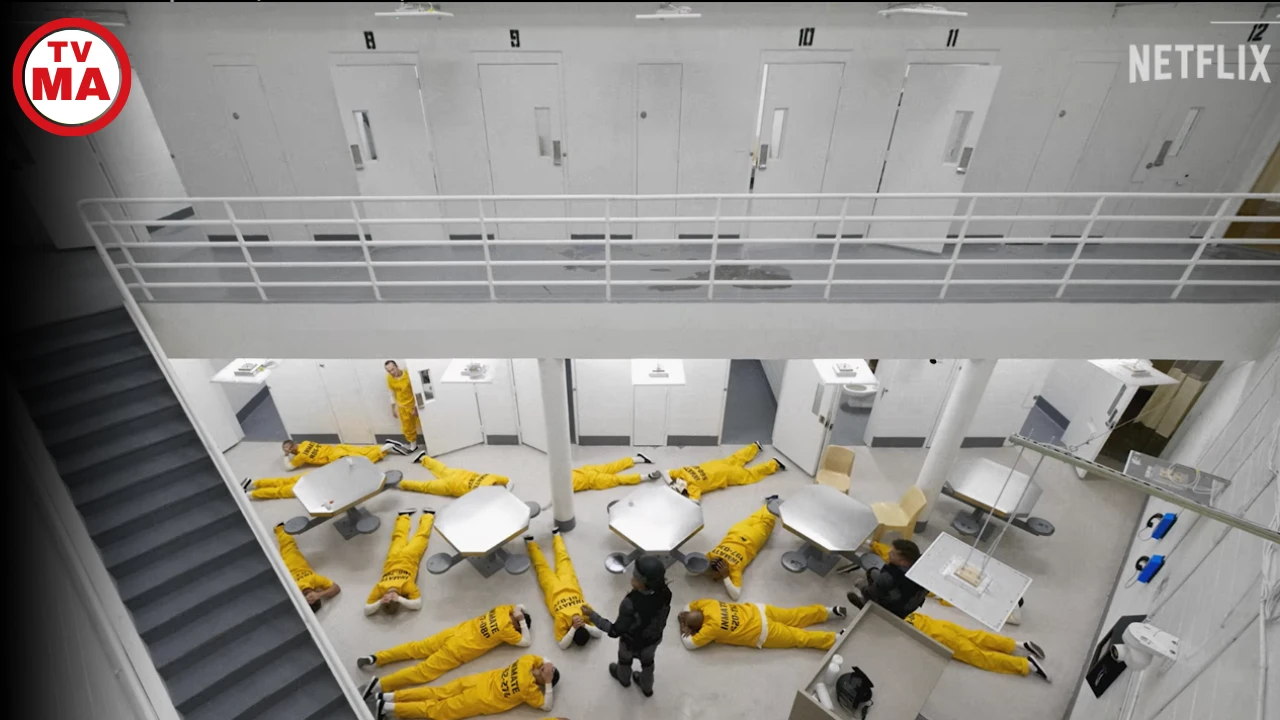
The New Stanford Prison Experiment is a 2026 American unscripted reality docuseries about psychology, authority, and human behavior.
The six-part series explores what happens when ordinary people are placed inside a simulated prison system. Alfred Street Industries produces the series, and Jane Lipsitz, Dan Cutforth, Nan Strait, Dan Volpe, Jeff Grogan, and Mike Odair executive produce it. The experiment places 30 participants inside an authentic closed prison facility for a planned two-week stay.
Participants are randomly assigned as guards or prisoners, creating a controlled environment where power, obedience, resistance, and psychological pressure become central to the experiment. The series revisits the ideas behind Dr. Philip Zimbardo’s controversial 1971 Stanford Prison Experiment. The New Stanford Prison Experiment premieres October 21, 2026, on Netflix.
The New Stanford Prison Experiment Age Rating
The New Stanford Prison Experiment is rated TV-MA for mature audiences only. The rating reflects its intense psychological themes, disturbing situations, strong language, confrontational behavior, and mature exploration of abuse of power.
Violence & Peril
The series contains moderate to strong violence and physical aggression. Much of the tension comes from confrontations between participants rather than conventional action violence. Guards and prisoners may engage in aggressive standoffs, intimidation, restraint, physical struggles, and attempts to enforce control.
The prison setting creates a constant atmosphere of tension and uncertainty. Conflicts can escalate when prisoners resist authority or guards attempt to maintain order. Parents should expect emotionally intense confrontations, threatening behavior, and situations involving forced compliance.
Language
The series contains strong language and frequent profanity. Participants are placed under significant emotional pressure, which can lead to angry arguments, insults, shouting, and vulgar language.
Some conversations may also include derogatory or hostile remarks during confrontations. Parents should not expect the language to be edited to a family-friendly level.
Mature Themes
Mature themes are the strongest reason for the TV-MA rating. The series examines abuse of authority, humiliation, confinement, psychological distress, manipulation, conformity, institutional control, and loss of empathy.
Participants may experience significant emotional pressure during the experiment. The format also deals with panic, fear, isolation, resistance, and psychological breakdowns. The series can be disturbing because the participants’ reactions are presented as part of an unscripted social experiment.
Parents should also be aware that the prison environment can involve references to mental health, emotional trauma, intimidation, and degrading treatment. The series is not designed as light entertainment despite its reality-TV format.
Is The New Stanford Prison Experiment Suitable for Teens?
Ages 13–15: No. This series is not recommended for younger teenagers. The TV-MA rating reflects strong language, psychological distress, aggressive confrontations, and mature themes involving institutional abuse and manipulation.
Ages 16–17: With Guidance. Older teens may understand the psychological and social issues explored in the series. However, the intense prison environment, profanity, emotional breakdowns, and confrontational behavior make parental guidance advisable.
Ages 18+: Yes. Adults are the intended audience. Viewers interested in psychology, social experiments, reality television, or the history of the Stanford Prison Experiment may find the series particularly relevant.
Final Recommendation: The New Stanford Prison Experiment is best suited for adults aged 18 and older. Older teens should only watch with parental guidance if they are comfortable with intense psychological themes and strong language.
What Parents Can Do
- Explain the original experiment: Parents can explain that the series revisits ideas connected to the controversial 1971 Stanford Prison Experiment and its debates about authority and human behavior.
- Discuss ethical issues: Talk about consent, psychological safety, power, and the responsibilities of researchers and producers when people participate in social experiments.
- Talk after watching: Encourage teens to discuss whether the participants’ behavior was caused by the environment, individual choices, group pressure, or the authority structure.
Official Trailer
FAQs
Q: Is The New Stanford Prison Experiment suitable for kids or young teens?
A: No. The series contains strong language, psychological distress, aggressive confrontations, and mature themes surrounding power and institutional control.
Q: Is The New Stanford Prison Experiment scary?
A: It is not a traditional horror series, but it can be disturbing and stressful. The prison environment, confrontations, isolation, intimidation, and emotional breakdowns may be upsetting for younger viewers.
Q: Does The New Stanford Prison Experiment contain bad language?
A: Yes. Strong profanity, insults, vulgar language, and hostile arguments are expected, particularly during stressful confrontations between participants.
Q: Where can I watch The New Stanford Prison Experiment?
A: The New Stanford Prison Experiment premieres exclusively on Netflix on October 21, 2026. It has six episodes of about 45 minutes each.