
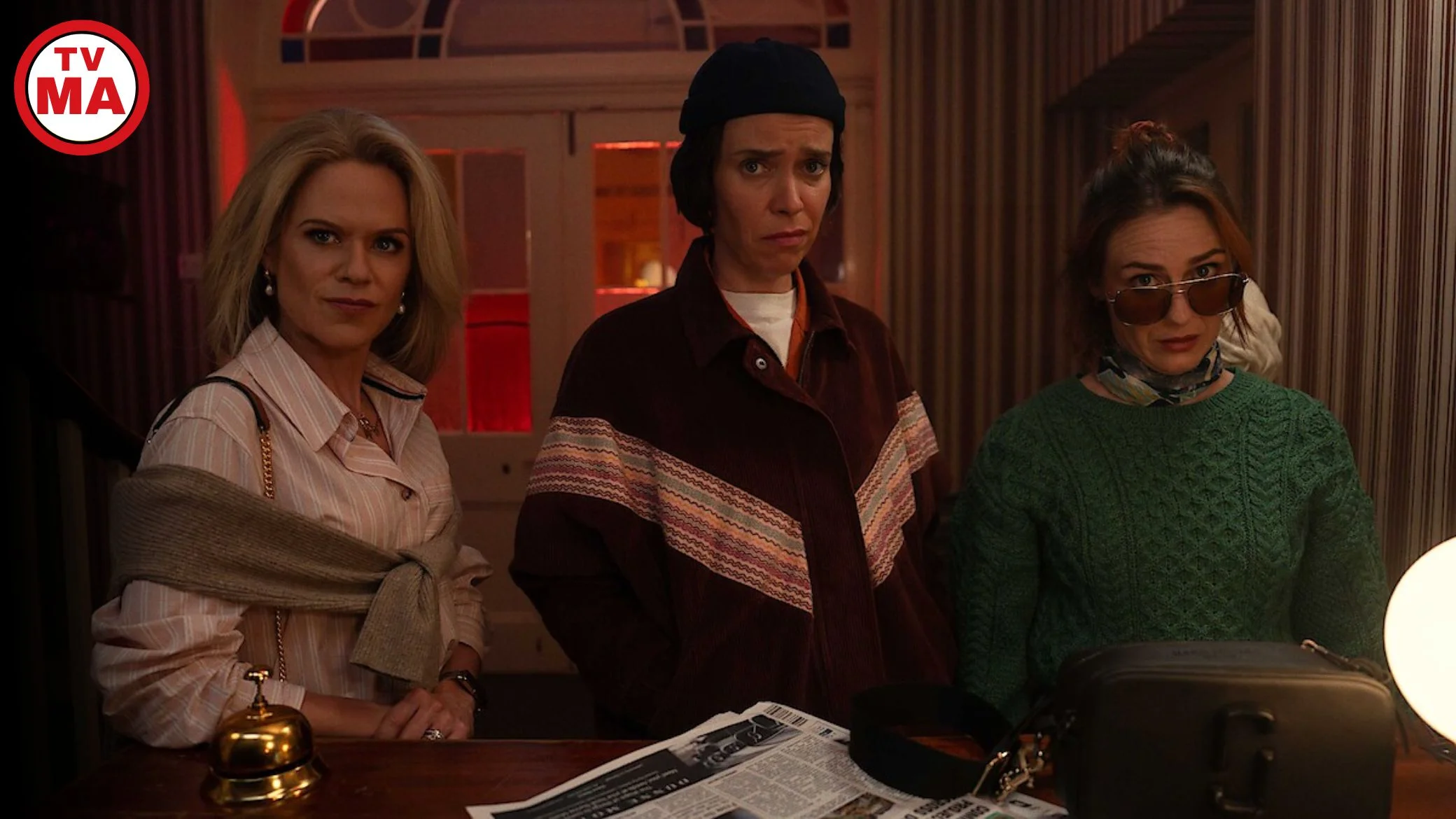
How to Get to Heaven from Belfast is a 2026 British comedy-thriller series from Northern Ireland that blends dark humor with mystery and suspense. Created and written by Lisa McGee, best known for Derry Girls, the series explores friendship, memory, and unresolved trauma through a genre-bending lens.
The show stars Roísín Gallagher, Sinéad Keenan, and Caoilfhionn Dunne as three lifelong friends whose adult lives are disrupted by a shocking death from their shared past. Supporting cast members include Saoirse-Monica Jackson, Emmett J. Scanlan, and Ardal O’Hanlon.
The story begins when the women learn that Greta, a former friend they had fallen out with years earlier, has died. What starts as a reunion at her wake spirals into a strange and unsettling journey across Ireland. As secrets resurface, the trio is forced to confront long-buried truths.
The eight-episode series was filmed entirely on location in Northern Ireland and is scheduled to premiere globally on Netflix on February 12, 2026.
How to Get to Heaven from Belfast Age Rating
How to Get to Heaven from Belfast is rated TV-MA. This rating indicates the series is intended for adult audiences and may not be suitable for viewers under 17 due to its content and tone. It’s funnier and lighter in tone than most thrillers, but underneath the sharp wit and 90s girl-power anthems lies a genuinely dark story about childhood abuse, cult trauma, covered-up deaths, and decades of unresolved guilt. It earns its rating.
Language
This is the most immediately noticeable content element for parents, and it’s worth knowing upfront: the characters talk fast, swear colorfully, fluster easily, and verbally charge passionately into any circumstance, especially when they’re wrong.
Strong profanity is woven throughout the series. One character, Robyn, is explicitly described as “sweary” — she fires off lines like “We’re not the f*in’ A-Team, Saoirse!” with total conviction. The F-word appears constantly across all eight episodes, used as punctuation, emphasis, and expression of frustration in equal measure. Other strong language includes “bch,” “bastard,” and various creative Irish insults that the characters deploy as affection as much as hostility.
Violence and Gore
Violence in this series tends to be more shocking in the reveal than graphic in the depiction, but there are moments that will genuinely unsettle viewers.
A man is discovered dead with a screwdriver in his neck — the discovery is played as a genuine shock moment. In the finale, one of the main characters is accidentally struck by a car. She survives but is seen bloodied and seriously injured, patching herself up with stolen alcohol in a gas station bathroom while sporting a nasty gash across her side.
The show’s backstory also carries significant violent weight. As young girls, the central mystery figure Greta and her sister were mercilessly abused by their mother and raised in a cult. When God did not intercede to save them, they burned down the cult’s church — not realizing there were children inside. This event is depicted through visual flashes and dialogue rather than extended graphic sequences, but the weight of what happened is made very clear and is genuinely disturbing when the full picture comes together.
Flashbacks to this pivotal past event include a forest shack on fire, a menacing adult figure, and symbols on the wall that have a sinister, cult-like appearance. There’s also a scene involving a near-fatal boat explosion and a sequence where a character fires a gun, with the bullet stopped only by luck.
Violence here is not frequent or gratuitous in the action-movie sense, but when the show goes dark, it goes genuinely dark.
Sexual Content and Nudity
Sexual content is minimal and not a primary concern for most parents. There is one scene in the finale where two characters are shown partially undressed and beginning to be intimate, though this is interrupted almost immediately and nothing explicit is depicted. The moment is brief, played more for comedic awkwardness than titillation, and there is no nudity.
Elsewhere, there are adult jokes and sexually suggestive dialogue woven into conversations — this is a show about three women in their late thirties being very unfiltered with each other, so adult humor is part of the texture. But compared to many other TV-MA dramas on Netflix, the sexual content here is genuinely mild.
Mature Themes Parents Should Know About
This is where the show’s real weight lives, and it’s worth discussing with your teenager if they do end up watching.
How to Get to Heaven from Belfast deals heavily with childhood abuse and the long shadow it casts into adult life. Greta and her sister Jodie were raised in a cult called Heaven’s Veil, where they were mercilessly abused by their mother and prayed repeatedly for God to save them. When no help came, they took matters into their own hands in a way that had devastating unintended consequences. The show handles this material with more restraint than many dramas would, but it doesn’t soften it either. The trauma is real, the damage is lasting, and the story asks hard questions about cycles of abuse, institutional silence, and what it means to carry a secret for twenty years.
The series also contains explicit anti-religious themes, particularly centered on the traumatic backstory involving abused children burning down a church out of a feeling of abandonment by God. Jokes about the Troubles, Catholic-run schools, and Irish political history are woven throughout, some of this will sail over younger viewers’ heads, but the religious and political context adds layers that parents might want to be aware of.
The show also explores the idea of three adult women covering up what they know about a crime — making morally questionable decisions, lying to police, and running from the consequences of choices made as teenagers. None of this is presented as admirable, but it is presented as understandable, and the show doesn’t rush to judge its characters. That moral ambiguity is rich territory for older teens who can engage with it critically — but it’s not straightforward viewing for younger or more impressionable audiences.
There are also brief elements of occult imagery and Celtic folklore woven into the mystery — symbols, a ghost-story framing, and suggestions of supernatural significance that add atmosphere without ever fully committing to anything supernatural.
Alcohol and Substance Use
Alcohol is present throughout, consistent with the setting — characters drink at the pub, at the wake, and in moments of stress. None of it is glamorized. Drinking is more a cultural backdrop than a thematic focus, and there’s no drug use of note.
Is How to Get to Heaven from Belfast Appropriate for Your Family?
Here’s the honest breakdown:
Under 13: No. The language alone makes this inappropriate, and the themes of cult abuse, childhood trauma, covered-up deaths, and moral complexity are simply not suited for this age group.
Ages 13–14: Not recommended. The pervasive strong language and the darkness of the show’s backstory — particularly the child abuse and church fire — are too mature for most early teens, even those who are generally comfortable with TV dramas.
Ages 15–17: Possibly, with the right context. Mature high schoolers who already watch adult dramas and can engage thoughtfully with complicated moral questions may genuinely get a lot out of this show. The humor is sharp, the friendships feel real, and the themes around trauma, identity, and the choices we make under pressure are worth discussing. Just be prepared to talk about the cult abuse storyline and the show’s portrayal of religion, morality, and institutional failure — because those threads run deep.
Ages 18+: This show is exactly what it’s designed for — adult viewers who can hold comedy and darkness in the same hand. It’s a darkly funny adventure through Ireland, reopening old wounds and finding unexpected humor in genuinely messy situations. Go in knowing the tone shifts significantly as the season progresses, and the back half gets considerably heavier than the first.
Official Trailer
FAQs
Q: What is the age rating for How to Get to Heaven from Belfast?
A: The series is rated TV-MA for strong language, mature themes, and moderate violence.
Q: Is How to Get to Heaven from Belfast appropriate for kids?
A: No, the series is not suitable for children due to adult themes and language.
Q: Is it suitable for teenagers?
A: It may be appropriate for older teens with parental guidance, but it is designed for adults.
Q: Are there violent or scary scenes?
A: Yes, there are tense and unsettling moments tied to death and mystery, though violence is mostly implied.
Q: Does the series include sexual content?
A: There are mature references and adult conversations, but explicit sexual scenes are not the main focus.
Q: Where can I watch How to Get to Heaven from Belfast?
A: The series will stream exclusively on Netflix starting February 12, 2026.
Feature Image Credit: Netflix Tudum