
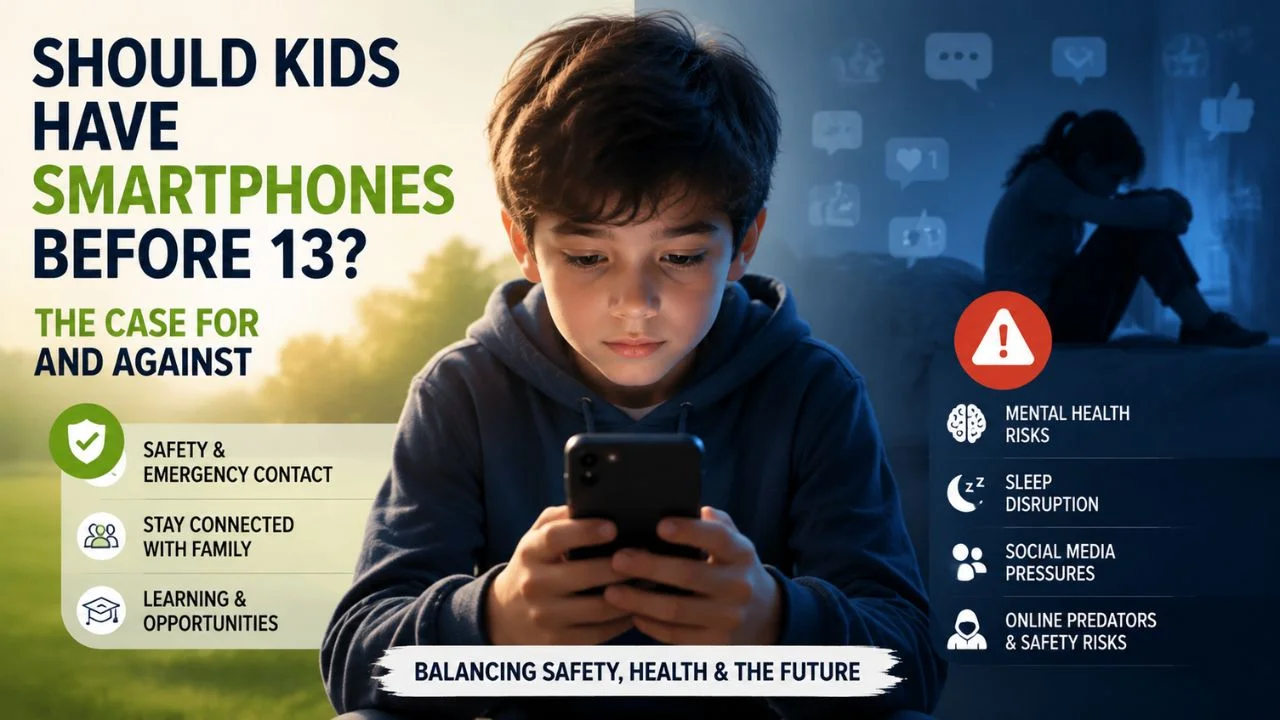
Few parenting decisions spark more disagreement today than this one. Some families see a smartphone before 13 as a safety tool and social necessity. Others treat it as handing a child a loaded weapon. Both sides have real points — and increasingly, so does the science.
The research that has emerged in 2024 and 2025 is among the most significant on this topic in years. This article lays out the genuine case on both sides — and lets you make the decision that is right for your child.
| Where Things Stand in 2026: 95% of US teens aged 13–17 own a smartphone (Pew Research Center, 2024) More than 50% of children aged 11–12 own one Nearly 30% of children aged 8–10 own a smartphone 8% of parents report their under-5 child has a smartphone Average age of first smartphone in the US: around 10–11 years old |
What the Research Actually Says in 2025
Two major peer-reviewed studies published in 2025 have reframed this debate significantly. Their findings are specific, large-scale, and difficult to dismiss.
Study 1 — Journal of Human Development and Capabilities (July 2025)
Researchers analyzed self-reported data from more than 100,000 young adults aged 18–24, asking them about smartphone acquisition age and current mental health symptoms. The findings were striking:
- People who got smartphones before age 13 had significantly higher rates of suicidal thoughts, aggression, emotional dysregulation, low self-worth, and detachment from reality
- The effect was dose-dependent — for every year earlier than 13 that a child received a smartphone, mental health outcomes were measurably worse
- Among women who received smartphones at ages 5–6, 48% reported severe suicidal thoughts as young adults, compared to 28% of those who received phones at 13 or older
- Early social media access explained approximately 40% of the link between early smartphone ownership and poor mental health outcomes
Source: Journal of Human Development and Capabilities, July 21, 2025 | Reported by CNN, CBS News, ScienceDaily
Study 2 — Pediatrics / Children’s Hospital of Philadelphia (December 2025)
Researchers from Children’s Hospital of Philadelphia, UC Berkeley, and Columbia University analyzed data from over 10,000 US adolescents in the Adolescent Brain Cognitive Development (ABCD) Study — one of the largest long-term studies of brain development in children.
- Smartphone ownership at age 12 was associated with increased risks of depression, obesity, and insufficient sleep
- The younger the age of acquisition, the greater the risk of obesity and sleep disruption
- Children who did not have a smartphone by 12 but received one in the following year showed a greater risk of mental health problems at 13 compared to peers who waited longer
Source: Pediatrics, doi.org/10.1542/peds.2025-072941, December 2025 | Children’s Hospital of Philadelphia
| A Note on This Research: Both studies have limitations. The first relies on self-reported data from young adults looking back, which can introduce memory bias. The second shows association, not direct causation; depressed children may be more likely to receive phones as a coping measure, rather than phones causing depression. That said, both are large-scale, peer-reviewed, and consistent with a growing body of evidence. No serious researcher is currently arguing that early smartphone use is harmless. |
The Case Against Smartphones Before 13
1. Social Media Access Is the Core Risk
A smartphone before 13 is primarily a social media delivery device. Every major social platform — Instagram, TikTok, YouTube, Snapchat, Discord — requires users to be 13, in alignment with COPPA (Children’s Online Privacy Protection Act). But none verify age meaningfully. A child with a smartphone at 10 is, in practice, a child on social media at 10. The 2025 research shows that early social media access accounts for about 40% of the mental health damage linked to early smartphone ownership.
2. The Developing Brain Is Particularly Vulnerable
Children under 13 are in a critical period of brain development, particularly in the prefrontal cortex — the region responsible for impulse control, decision-making, and emotional regulation. This is the same region that makes adolescents less equipped to handle the psychological pressures of social comparison, public validation metrics (likes, followers), and the infinite scroll design of social apps. Exposure during this period may have outsized and lasting effects.
3. Sleep Disruption at a Critical Age
Research from the CHOP study and multiple previous analyses consistently links early smartphone ownership to insufficient sleep in children. Children aged 8–12 need 9–12 hours of sleep per night according to the American Academy of Sleep Medicine. Smartphones in bedrooms — which is where they almost always end up — are one of the leading causes of children not meeting this need, with knock-on effects on mood, academic performance, weight, and immune function.
4. Predatory Contact Risk
Children under 13 are less equipped to recognize and respond appropriately to online grooming, predatory contact, or manipulation. The FBI reports that the vast majority of sexual solicitations of minors online occur through messaging apps and chat features — the exact features a smartphone unlocks. Younger children lack the emotional and cognitive tools to handle these situations safely.
The Case for Smartphones Before 13
1. Safety and Emergency Contact
This is the most legitimate argument — and for many families, the one that tips the decision. A child who walks to school, takes public transport, or participates in after-school activities alone has a genuine need for a way to contact a parent in an emergency. The counterpoint is that this need can be met by a basic phone or a dedicated kids device rather than a full smartphone with internet access — but for many families, a smartphone is the practical solution.
2. Social Inclusion Is a Real Concern
Social dynamics at school are real, and being the only child without a way to participate in group chats can genuinely isolate a child from their peer group. This is not a trivial concern — social belonging is a core developmental need at this age. Parents who have decided against smartphones before 13 often report that managing the social fallout requires active parental involvement in facilitating alternative ways for their child to stay connected with friends.
3. Educational and Practical Value
A smartphone with appropriate parental controls and limited app access can be a genuinely useful learning tool — access to educational content, dictionaries, calculators, reading apps, and age-appropriate games. The question is whether this value justifies the access it also provides to everything else. Many child development experts argue it does not, and that the educational benefits can be delivered through supervised, non-smartphone devices.
4. Digital Literacy Has to Start Somewhere
Some parents argue that shielding children entirely from smartphones creates a different problem — a child who arrives at 13, or 16, or 18 with no experience navigating digital environments and then must figure it out without parental guidance. A graduated introduction to digital tools — with significant parental oversight — is how some families intentionally build digital literacy rather than leaving it to chance.
The Middle Ground: What Many Families Are Choosing
The binary of having a smartphone vs. not having one is increasingly being replaced by a third option. A growing number of parents are turning to purpose-built alternatives:
| Option | What It Offers | Best For |
| Basic call/text phone | Calls and SMS only — no internet, no apps | Under 10s who need emergency contact only |
| Gabb Phone / Pinwheel | Call, text, GPS — no social media or browser | Ages 8–12 who need contact but not full internet |
| Supervised smartphone | Full phone with parental controls, no social apps | Ages 11–12 with active parental monitoring |
| Full smartphone at 13+ | Complete access, managed with ongoing conversation | Teens 13+ with established digital literacy baseline |
The phone-free movement in schools is also gaining traction in the US, UK, and Canada — with France, Italy, and several US states implementing school bans. This shift is relevant for parents deciding when a smartphone is necessary, since children increasingly spend school hours in an environment where phones are not permitted.
Our Verdict
The weight of the evidence in 2025 points in one direction: the earlier a child gets a smartphone, the worse the average mental health outcome — and the relationship is not small or ambiguous. For every year before 13 that a smartphone arrives, measurable harm accumulates.
That does not mean every child who gets a phone at 11 will struggle, or that every child who waits until 14 will thrive. Individual circumstances, family culture, parental involvement, and the specific child’s maturity all matter enormously. But the ‘default yes’ that many parents have operated on — giving a phone when the child asks, or when peers have one — is harder to justify after the 2025 research.
The most defensible position: delay the full smartphone for as long as practically possible, use purpose-built alternatives to meet genuine safety and contact needs, and when a smartphone does arrive, set it up with parental controls before handing it over — not after.
Practical Steps for Every Stage
- Under 10: No smartphone. A basic GPS tracker or kids watch covers safety needs without internet access.
- Ages 10–12: Consider a Gabb, Pinwheel, or similar purpose-built device. If a smartphone is given, use Google Family Link or Apple Screen Time to block social media apps and browsers.
- Age 13: If introducing a smartphone, set up parental controls before handing it over. Agree on rules together — especially around social media, bedtime, and who can contact them.
- Any age: Keep devices out of bedrooms at night. This single rule prevents more harm than almost any other intervention.
References
Sapien Labs / Tara Thiagarajan (2025). Smartphone Age and Mental Health. Journal of Human Development and Capabilities, July 21, 2025. Reported by CNN, CBS News, and ScienceDaily.
Children’s Hospital of Philadelphia, UC Berkeley & Columbia University (2025). Smartphone Ownership in Early Adolescence and Mental Health. Pediatrics, doi.org/10.1542/peds.2025-072941, December 2025.
Pew Research Center (2024). Teens and Technology. pewresearch.org
American Academy of Pediatrics — Children and Media: healthychildren.org
American Academy of Sleep Medicine — Sleep Guidelines for Children: aasm.org
Washington Post (December 28, 2025). Giving a kid a phone before this age can be especially harmful.
SEO DETAILS — JSAN MEDIA
Primary Title (57 chars):
Alt Title:
Meta Description (158 chars):
New 2025 research links smartphones before age 13 to suicidal thoughts and depression. We break down both sides of the debate and give parents a clear, evidence-based verdict.
Internal Links:
Screen Time by Age article (anchor: ‘) | Gaming Addiction article (anchor: ‘how devices affect developing brains’)