
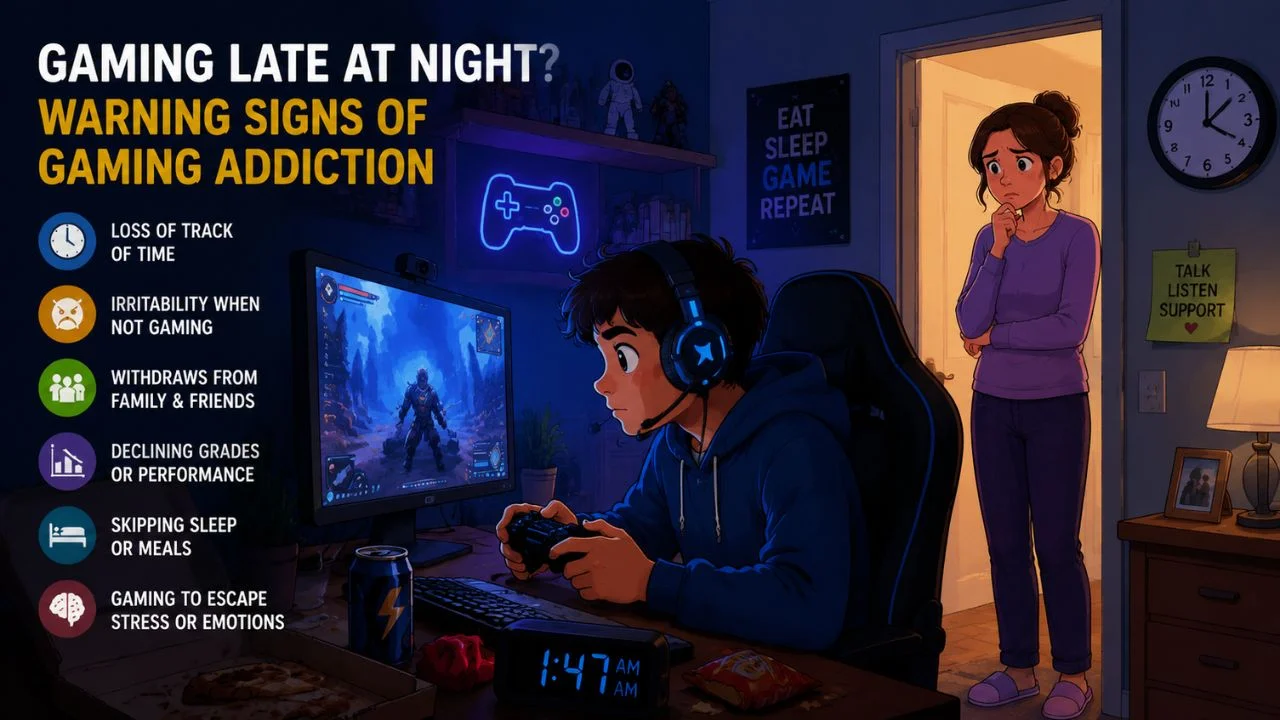
It starts innocently enough. Your child discovers Minecraft, or Fortnite, or Roblox. They’re engaged, they’re having fun, and honestly — it keeps them occupied. But somewhere along the way, something shifts. The gaming sessions get longer. Getting them off the console becomes a battle. They stop wanting to go outside. They’re irritable, secretive, and increasingly disconnected from everything in their lives that isn’t a screen.
At some point, many parents find themselves wondering: is this just a phase, or is something more serious going on?
Gaming addiction — formally recognized by the World Health Organization as Gaming Disorder since 2018 — is a real, documented condition that affects a meaningful percentage of children and teenagers worldwide. It is not simply a label for kids who like video games too much. It is a clinical pattern of behavior that causes genuine harm to development, mental health, academic performance, and family relationships.
This guide gives you everything you need to understand it: what the science actually says, how to tell the difference between a hobby and a disorder, what the warning signs look like in real life, and — most importantly — what to do if you think your child might be struggling.
What Is Gaming Addiction? The Clinical Picture
Gaming addiction goes by several clinical names. The World Health Organization (WHO) included Gaming Disorder in the International Classification of Diseases, 11th Revision (ICD-11) in 2018 — making it an officially recognized medical diagnosis. The American Psychiatric Association’s Diagnostic and Statistical Manual of Mental Disorders (DSM-5-TR, 2022) lists Internet Gaming Disorder as a condition warranting further study, though it has not yet been formally classified as a full disorder in the US system.
Regardless of the naming debate, clinicians worldwide take the condition seriously. Gaming Disorder is defined by three core characteristics that must be present for at least 12 months and must cause significant impairment in personal, social, academic, or professional functioning:
| Core Criterion | What It Looks Like in Practice |
| Impaired control over gaming | Cannot stop playing when they want to, cannot limit sessions, gaming always exceeds planned time |
| Increasing priority given to gaming | Gaming dominates daily life over other interests, friendships, school, family, and responsibilities |
| Continuation despite harm | Keeps gaming even when it’s clearly causing problems — bad grades, damaged relationships, poor health |
It is important to understand what gaming addiction is not. Playing video games for long periods during school holidays is not an addiction. Being passionate about gaming as a hobby is not an addiction. Even playing daily is not automatically a disorder. The defining feature is loss of control combined with real-world harm — not hours per day or a particular game title.
| The Numbers — How Common Is This? According to a 2024 meta-analysis published in Public Health in Practice, approximately 8.6% of adolescents worldwide show signs of Gaming Disorder — more than four times the adult prevalence rate. In the United States specifically, around 8.5% of children and teenagers aged 8 to 18 exhibit signs of problematic gaming. Globally, an estimated 60 to 65 million people meet diagnostic criteria for Gaming Disorder as of 2025, with adolescents and young adults at the highest risk. Males are affected at roughly 2.5 times the rate of females. |
Why Video Games Are Specifically Designed to Be Hard to Stop
Understanding gaming addiction requires understanding how modern video games are engineered. This is not an accident of their popularity — it is a deliberate design strategy employed by game developers to maximize engagement, session length, and spending.
The Dopamine Loop
Video games are masterfully designed to trigger the brain’s dopamine reward system — the same system involved in other behavioral addictions. Every time a player levels up, earns a reward, defeats an enemy, or gets a notification that friends are online, a small hit of dopamine is released. The brain learns to seek this feeling, and the cycle repeats. For children and teenagers whose brains are still developing, particularly the prefrontal cortex responsible for impulse control and long-term decision-making, this loop is especially powerful.
Variable Reward Schedules
The most addictive games use a psychological principle called variable ratio reinforcement — the same mechanism that makes slot machines impossible to walk away from. Instead of rewarding players at predictable intervals, games deliver rewards (rare items, wins, level-ups) unpredictably. The unpredictability itself creates compulsion. Players keep going because the reward might come on the very next attempt.
Social Pressure and FOMO
Multiplayer games — Fortnite, Roblox, Call of Duty, League of Legends — create social environments where quitting means letting your team down, missing events, or falling behind your friends. The social stakes are real to children and teenagers. Being offline means being excluded. This social dimension makes stopping feel like a social cost, not just a personal preference.
Loot Boxes and Microtransactions
Many popular games contain loot boxes — randomized virtual reward crates purchased with real money or in-game currency. Multiple countries, including Belgium and the Netherlands, have classified certain loot box mechanics as gambling. For children, the combination of randomized rewards and real financial stakes creates a particularly potent addictive loop. Parents should be aware of which games their children play contain these mechanics.
No Natural Stopping Points
Traditional games had a clear ending. Modern online games are designed to be endless — there is always another season, another challenge, another event. The phrase ‘just one more game’ is not a character flaw in your child; it’s the intended experience. Games without natural stopping points remove the environmental cues that would normally signal it’s time to stop.
Warning Signs of Gaming Addiction in Children: What to Look For
This is the section most parents come looking for — and it’s worth reading carefully. The following warning signs are drawn from clinical diagnostic criteria and expert consensus. No single sign in isolation constitutes an addiction. Look for a pattern of several of these signs persisting over time.
Behavioral Warning Signs
- Loss of time control: Gaming sessions regularly run far longer than planned. Your child says ‘five more minutes’ repeatedly and cannot actually stop without significant external intervention.
- Intense preoccupation: Even when not gaming, they are thinking and talking about gaming constantly — the next session, strategies, other players, upcoming game releases. Gaming dominates their mental life.
- Lying and deception: Hiding gaming activity, lying about how long they’ve been playing, secretly gaming at night after bedtime, or using a second device you don’t know about.
- Abandoning other interests: Hobbies, sports, creative activities, and friendships that once mattered have been progressively abandoned in favor of gaming. The withdrawal from non-gaming life is gradual but cumulative.
- Failed attempts to cut back: Your child has genuinely tried to reduce their gaming — and has been unable to do so consistently. This is a key clinical indicator of disorder versus heavy use.
- Gaming to escape or cope: Playing specifically to avoid thinking about problems, to escape negative emotions, anxiety, or depression — rather than for entertainment or fun.
Emotional and Psychological Warning Signs
- Disproportionate anger or distress when stopped: Explosive anger, crying, or severe distress when gaming is interrupted or devices are removed — a response that feels out of proportion to the situation. This is different from normal disappointment.
- Withdrawal symptoms: Genuine symptoms of anxiety, irritability, restlessness, and low mood when unable to game — symptoms that lift when they return to gaming. This mirrors withdrawal patterns seen in substance addiction.
- Mood dependency: Your child is only in a good mood when gaming, and progressively irritable, flat, or unhappy at other times. Gaming has become their primary — or only — source of positive emotion.
- Increased anxiety or depression: Children with Gaming Disorder show significantly higher rates of anxiety and depression than peers. Sometimes gaming is a symptom of underlying mental health struggles; sometimes it causes them. Often, it’s both.
Physical Warning Signs
- Sleep disruption: Gaming late into the night, going to bed long after agreed times, severe difficulty waking up in the morning, chronic fatigue during the day. A 2024 US survey of teenagers found that 41% of daily gamers attributed sleep problems directly to their gaming habits.
- Skipping meals: Refusing to eat, eating at the device, or significantly delaying meals to avoid interrupting gaming sessions.
- Physical complaints: Persistent headaches, eye strain, back and neck pain, or wrist and hand problems from extended gaming without breaks.
- Neglecting hygiene: Skipping showers, not brushing teeth, or wearing the same clothes for extended periods because personal hygiene feels less urgent than the next gaming session.
Academic and Social Warning Signs
- Declining grades: A measurable drop in academic performance that coincides with increasing gaming time, or homework and studying consistently being neglected in favor of gaming.
- Withdrawal from friends: Preferring online gaming relationships to in-person friendships. Declining invitations, not wanting to go out, canceling plans to stay home, and playing games.
- Trouble at school: Reports from teachers of inattentiveness, fatigue, or incomplete work. In some cases, truancy means staying home to play games.
- Social isolation: A meaningful reduction in real-world social interaction over time, with online relationships substituting for — rather than supplementing — in-person ones.
| Normal Gaming vs. Problematic Gaming — A Key Distinction: Heavy gaming is not the same as Gaming Disorder. A child who games for three hours daily but maintains friendships, does well at school, stops when asked, and is emotionally regulated is not showing signs of disorder. The clinical concern is not hours per se — it is loss of control, escalating priority over all other life areas, and real-world harm that persists despite awareness of the consequences. |
Which Games Carry the Highest Risk?
Not all games carry equal addiction risk. Research identifies specific game types and design features that are associated with higher rates of problematic use in children and teenagers.
| Game Category | Risk Level | Why |
| MMORPGs (World of Warcraft, Final Fantasy XIV) | Very High | Endless content, social guilds, no natural end points, strong identity investment |
| Battle Royale (Fortnite, PUBG, Warzone) | High | Short intense sessions that chain easily, social multiplayer, competitive ranking systems |
| Mobile Games with Gacha/Loot mechanics | High | Daily login rewards, variable loot boxes, low barrier to play anywhere anytime |
| MOBA / Competitive (League of Legends, Dota 2) | High | Ranked matchmaking, team pressure, long match lengths, toxic social dynamics |
| Survival/Sandbox (Minecraft, Roblox) | Moderate-High | Creative freedom with no end point; Roblox has additional social and spending elements |
| Story-Based Single Player Games | Lower | Natural end points, no social pressure, no live-service mechanics |
| Sports Simulations (FIFA, NBA 2K) | Moderate | Ultimate Team mode with loot mechanics elevates risk significantly |
Parents should note that Roblox deserves particular attention for younger children. It is technically a platform hosting thousands of user-created games rather than a single title — meaning content quality, safety, and addiction mechanics vary enormously across what appears on the surface to be one app. Some Roblox games contain sophisticated gambling-like mechanics. Age ratings for Roblox (rated E10+ by ESRB) apply to the platform, not to every individual game within it.
The Real Effects of Gaming Addiction on Children’s Development
Mental Health
Research published in multiple peer-reviewed journals consistently links Gaming Disorder in children and adolescents with significantly elevated rates of depression and anxiety. A 2025 meta-analysis on internet gaming disorders found that IGD symptoms were associated with symptoms of depression, anxiety, and substance use — and that adolescents with internet addiction show notably higher rates of suicidal ideation compared to peers. It is critical to note the bidirectional relationship: depression and anxiety can lead to problematic gaming as a coping mechanism, and problematic gaming can worsen depression and anxiety. This cycle can be difficult to untangle without professional help.
Academic Performance
Gaming Disorder in children is consistently associated with academic decline — lower grades, incomplete assignments, reduced ability to focus during class, and in more severe cases, school refusal or truancy. The mechanisms are several: displaced study time, chronic sleep deprivation impairing cognitive function, and reduced investment in academic goals that feel less immediately rewarding than gaming.
Sleep
The relationship between gaming and sleep disruption in children is one of the best-documented findings in this area. Gaming activates the nervous system, suppresses melatonin production, and creates mental stimulation that is incompatible with sleep. Children who game late at night — particularly common given that online games are more active in the evenings when friends are online — frequently report falling asleep in class, difficulty waking up, and chronic daytime fatigue.
Physical Health
Sedentary gaming for extended periods contributes to reduced physical activity, poor posture, repetitive strain injuries, and in severe cases, obesity. Children who game extensively often skip meals, eat less nutritiously, and spend far less time outdoors. The long-term physical health implications of sustained sedentary screen-based behavior in childhood are well documented.
Social Development
Healthy social development in childhood and adolescence requires practice — navigating conflict, reading body language, and developing empathy through shared physical experience. When online gaming relationships substitute for rather than supplement real-world friendships, children miss critical practice opportunities. Some children with Gaming Disorder develop what researchers describe as impaired social skills — difficulty in face-to-face interaction that becomes increasingly pronounced as gaming consumes more of their social life.
What to Do If You Think Your Child Has a Gaming Problem
Discovering that your child may be struggling with gaming addiction can feel overwhelming. The most important thing to know upfront is this: abrupt, punitive removal of devices without conversation or support is rarely effective and often counterproductive. Treatment specialists emphasize understanding, communication, and structured intervention over sudden prohibition.
Step 1: Assess Honestly — Is This a Problem or a Preference?
Before taking action, take an honest inventory. Is your child gaming excessively but still doing well at school, maintaining friendships, sleeping adequately, and able to stop when asked? If so, this may be intense engagement with a hobby rather than a clinical problem — and the response should be calibrated accordingly.
If you are seeing multiple warning signs from the sections above — particularly loss of control, withdrawal symptoms, declining academics, and social withdrawal — that is a more serious picture that warrants active intervention.
Step 2: Have the Conversation — Calmly and Curiously
The first conversation matters enormously. Approach it with genuine curiosity rather than accusation. Ask your child what they enjoy about gaming — connection with friends, the challenge, the escape, the sense of achievement. Understanding why they game gives you insight into what needs are being met by gaming that aren’t being met elsewhere.
Avoid making it a lecture about what they’re doing wrong. Adolescents disengage immediately from being talked at. Express what you’ve observed — changes you’ve noticed in their mood, their sleep, their friendships — and invite them to share their perspective. The goal of the first conversation is connection and understanding, not correction.
Step 3: Set Clear, Consistent Boundaries — Together Where Possible
Research consistently shows that limits co-created with children are more effective than limits imposed on them. Where possible, involve your child in setting gaming rules. A teenager who has participated in setting a two-hour daily limit is more likely to respect it than one who had it imposed without input.
Practical boundaries that work:
- No gaming before homework and household responsibilities are completed
- No gaming devices in bedrooms overnight — charge them in a common area
- Clear session limits with an agreed warning before time is up
- Gaming-free times: mealtimes, the hour before bed, and mornings before school
- Weekday vs. weekend distinctions — many families find stricter weekday limits and more flexibility on weekends a sustainable model
Step 4: Fill the Gap — This Is Critical
One of the most common mistakes parents make is removing gaming without providing anything to replace it. For a child who has been meeting their social, emotional, and achievement needs through gaming, simply taking it away leaves a vacuum — and typically creates significant distress and resentment.
Ask yourself: what does gaming give my child that they’re not getting elsewhere? If it’s social connection — help them build offline friendships or find a gaming club or esports team that provides structure. If it’s achievement and mastery — find activities that provide similar satisfaction. If it’s escape from anxiety or depression — that’s a mental health signal that deserves professional attention, not just device removal.
Step 5: Seek Professional Help When Needed
If gaming has significantly disrupted your child’s academic performance, mental health, or family relationships — or if you’ve tried setting boundaries and they’ve repeatedly broken down — it is time to involve a mental health professional. This is not a failure of parenting. Gaming Disorder is a recognized clinical condition with evidence-based treatments.
Cognitive Behavioral Therapy (CBT) is the most well-supported treatment for Gaming Disorder in children and adolescents. A January 2025 systematic review published in PLOS ONE, which analyzed 22 studies conducted between 2014 and 2025, found that CBT significantly reduced Gaming Disorder severity, anxiety, and depression in young people — with outcomes further improved when combined with physical exercise or mindfulness practices.
A 2025 meta-analysis in ScienceDirect found that CBT produced significantly lower addiction symptoms (effect size g = 0.72) compared to control groups across 13 studies involving over 1,100 participants, with an average age of 19 years.
Family therapy has also shown value — particularly for addressing the home dynamics and communication patterns that may be contributing to the problem. The goal of family therapy is not to assign blame but to develop a unified, supportive approach.
References: Park et al. (2025). Treatment of Gaming Disorder in Children and Adolescents: A Systematic Review. PubMed Central PMC12223676. | Cheng et al. (2025). Effects of CBT on addictive symptoms in IGD. ScienceDirect.
Step 6: Address Underlying Issues
Gaming Disorder in children rarely exists in isolation. Research consistently shows associations with ADHD, depression, anxiety, social difficulties, and family stress. A child who turns to gaming to escape loneliness, anxiety, academic pressure, or a difficult home environment needs those underlying issues addressed — not just their gaming removed.
If your child is using gaming specifically to cope with distress, emotional pain, or difficult circumstances, consider this a signal to look deeper. Speak with your pediatrician or a child psychologist about a comprehensive assessment.
Prevention: How to Build Healthy Gaming Habits From the Start
For parents of younger children who haven’t yet developed problematic patterns, prevention is far easier than treatment. These evidence-informed strategies help establish a healthy relationship with gaming from the beginning.
- Introduce gaming with structure from day one: Rather than allowing open-ended gaming and then trying to restrict it later, establish session limits from the first time your child plays. It is much easier to maintain a rule than to introduce one after habits are formed.
- Know the games your children play: Play alongside them occasionally, or at minimum understand the mechanics. Is the game endless? Does it have loot boxes? Does it penalize for logging off? Games with these features require closer supervision and firmer limits.
- Maintain non-gaming activities: Protect hobbies, sports, social time, and outdoor activities as non-negotiable. Gaming should compete for free time, not replace everything else.
- Keep devices out of bedrooms: This single rule prevents more late-night gaming than almost any other intervention. If the console or device isn’t in the bedroom, midnight gaming is much harder.
- Model healthy technology use: Children observe and replicate parental behavior. If you are constantly on your phone or device, the message that screens should have limits is undermined. Be intentional about your own device use at home.
- Stay connected: Children who have strong, warm relationships with their parents and feel genuinely heard and understood at home are less likely to use gaming as an escape. The relationship is, in the end, the most powerful protective factor.
When to Seek Help Immediately
While most gaming addiction situations can be addressed through the steps above over time, there are circumstances where you should seek professional help without delay:
- Your child is expressing thoughts of self-harm or suicide, particularly in connection with gaming being restricted
- They have completely stopped attending school
- They have become physically aggressive when devices are removed
- They have been gaming for 20+ hours continuously without sleep or food on multiple occasions
- You have found evidence of significant online spending — especially if they’ve used your payment details without permission
- They are severely socially isolated with no in-person friendships remaining
- Underlying depression or anxiety appears severe and is not improving
If your child is in immediate distress, contact your pediatrician, a child mental health crisis line, or your local emergency services. Gaming addiction in its severe forms is a medical situation, not a discipline problem.
The Bottom Line
Gaming addiction in children is real, clinically recognized, and more common than many parents realize. It is also treatable — especially when caught early, approached without shame, and addressed with the combination of understanding, firm boundaries, and professional support when needed.
The goal is not to make your child fear or hate gaming. Video games, at their best, offer genuine creativity, problem-solving, connection, and joy. The goal is to help your child develop a relationship with gaming that enriches their life rather than consuming it — one where they are in control of the game, and the game is not in control of them.
Pay attention to the patterns. Trust your parental instinct. Start the conversation early. And remember that no child who is struggling with gaming addiction is broken — they are a developing person who needs support navigating one of the most psychologically sophisticated environments human beings have ever created.
References & Further Reading
World Health Organization (2022). ICD-11 — Gaming Disorder. who.int/standards/classifications/frequently-asked-questions/gaming-disorder
American Psychiatric Association (2022). DSM-5-TR — Internet Gaming Disorder. psychiatry.org
Park J.J. et al. (2025). Treatment of Gaming Disorder in Children and Adolescents: A Systematic Review. PubMed Central, PMC12223676.
Cheng H. et al. (2025). Effects of CBT on addictive symptoms in internet gaming disorders: A systematic review and meta-analysis. ScienceDirect, doi.org/10.1016/j.psychres.2025.02.007
Stevens M.W.R. et al. (2021). Global Prevalence of Gaming Disorder: A Systematic Review and Meta-analysis. Australian & New Zealand Journal of Psychiatry.
Pew Research Center (2024). Teens and Video Games Today. pewresearch.org/internet/2024/05/09/teens-and-video-games-today
WebMD (2025). Video Game Addiction: Symptoms, Treatment, and Prevention. Medically reviewed by Jabeen Begum, MD.
Children and Screens (2024). Warning Signs of Video Game Addiction — #AskTheExperts webinar with Dr. Alok Kanojia. childrenandscreens.org
Newport Academy (2025). Teen Gaming Addiction: Signs and Help. newportacademy.com
Neuro Wellness Spa (2025). Gaming Addiction in Teens: Is Your Child Affected? neurowellnessspa.com