
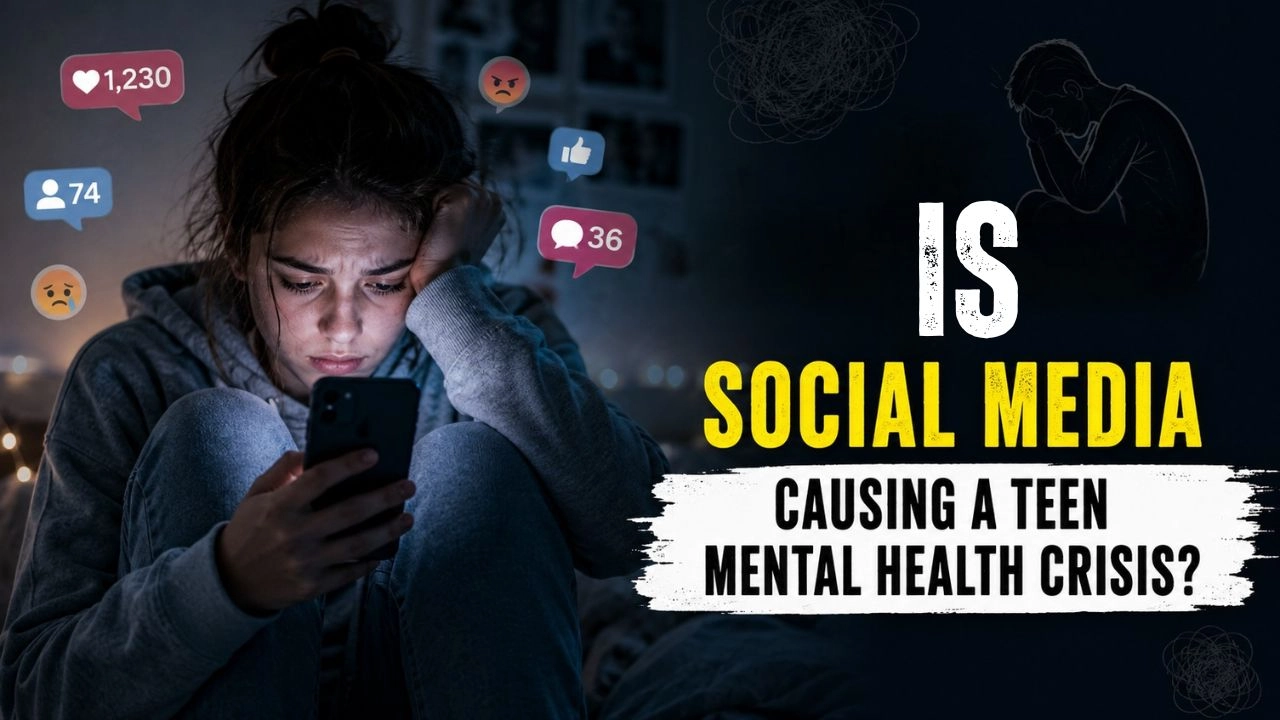
Something Changed Around 2012
The data is not subtle. In the United States, the United Kingdom, Canada, and Australia — countries with very different cultures, healthcare systems, and social structures — teenage mental health began declining sharply at almost the same time. Rates of anxiety, depression, self-harm, and suicide among adolescents, particularly girls, started rising steeply around 2012 and have not meaningfully recovered since.
Epidemiological data show that rates of anxiety, depression, self-injurious behaviors, and suicidality increased for Gen Z in significantly higher numbers than previous generations. The question that has consumed researchers, policymakers, and parents for the past decade is simple and still not entirely settled: why?
One answer has become impossible to ignore. 2012 was also the year smartphones became ubiquitous among teenagers, and when Instagram, Snapchat, and Twitter reached mass adoption in that age group.
The argument that these two facts are causally connected, not just correlated, has been made most forcefully by Jonathan Haidt, a social psychologist at NYU’s Stern School of Business, in his 2024 book The Anxious Generation: How the Great Rewiring of Childhood Is Causing an Epidemic of Mental Illness. As of April 2025, the book catalyzed Australia’s Online Safety Amendment, a law that restricts the use of social media by minors under 16
This article lays out the case Haidt and others have made, the serious criticisms leveled against it, what the research genuinely supports, and what it means for parents making decisions right now.
The Case: Smartphones Rewired Childhood
Haidt’s core argument is that the rapid spread of smartphones and the decline of independent, play-based childhood together caused the mental health crisis. He draws on developmental psychology, neuroscience, and cross-cultural research.
Haidt identifies four foundational harms: social deprivation (as kids spend less time with others and more time on screens), sleep deprivation (as screens negatively affect sleep), attention fragmentation (as phones constantly interrupt and distract), and addiction (as kids become hooked on their devices).
The evidence Haidt marshals is genuinely significant:
- Studies establishing a causal relationship between Facebook adoption and depression and anxiety — particularly for girls — are cited in the book. Internal Instagram research reported that the platform makes body image issues worse for one in three teenage girls.
- Haidt testified before Congress in 2022 that one to two hours a day of social media use is not associated with declining mental health — but three to four hours a day is.
- The timing argument: the mental health decline tracks almost exactly with the rise of the smartphone era across multiple countries simultaneously — a pattern harder to explain with domestic policy differences or economic factors alone.
- Girls are disproportionately affected, and Instagram and Snapchat, the platforms most associated with social comparison and appearance pressure, skew heavily female in teen usage.
Haidt’s main argument is that the widespread adoption of smartphones, particularly with the rise of social media platforms, has led to a mental health crisis that is hitting this generation harder than any before, with young people exposed to constant comparison, cyberbullying, and the endless pursuit of validation through likes and comments.
👉 For the neuroscience behind why social media affects developing brains differently, see our article on how social media changes the teenage brain — what neuroscience says.
The Four Foundational Harms — Explained
1. Social Deprivation
Before smartphones, children spent after-school hours in largely unstructured, in-person social environments — neighborhood play, sports, hanging out. These interactions, including the conflict and awkwardness they contained, built the emotional and social skills that adult life requires.
Social life has migrated to screens. The volume of social interaction has not necessarily decreased — but its quality and developmental value have changed fundamentally. Digital interaction does not require the same emotional regulation, nonverbal communication skills, or tolerance for ambiguity that in-person interaction demands. Children are socializing more but practicing less.
2. Sleep Deprivation
Haidt identifies sleep disruption as one of the four core mechanisms through which smartphones damage adolescent development. The evidence here is among the strongest in the field — blue light suppresses melatonin, emotionally stimulating content hyperactivates the nervous system before bed, and social anxiety about notifications creates sleep-incompatible mental states. Teenagers are sleeping less than they were before smartphones — and the consequences for mood, cognition, and mental health are measurable and significant.
3. Attention Fragmentation
The average teenager receives dozens of notifications per day — each one a small interruption that trains the brain to expect constant novelty and to resist sustained concentration. The capacity for deep focus — essential for academic achievement, creative work, and emotional regulation — is undermined by an environment of continuous partial attention. Haidt argues that screens weaken the capacity to regulate emotions, maintain focus, and retain information, interfering with neurological processes still in development.
4. Addiction
Social media and smartphones are designed with the same behavioral psychology principles used in gambling machines — variable reward schedules, social validation triggers, and infinite content loops. Haidt argues that more young people are glued to their phones, exposed to the pressures of constant comparison, cyberbullying, and the endless pursuit of validation through likes and comments — and that these platforms are engineered to maximize this engagement regardless of the harm it causes.
The Critics — And Why They Matter
Haidt’s thesis is compelling and influential. It is also genuinely contested, and any honest account of this debate requires presenting the counterarguments seriously.
Amy Orben — Oxford University: One of the most prominent academic critics, Orben has published peer-reviewed work arguing that the statistical relationship between social media use and adolescent mental health is small — comparable, famously, to the negative effect of eating potatoes. Orben sees no clear evidence for the causal link Haidt asserts, and the LSE Review of Books noted that while there is a large body of research on the topic, it is “by no means unequivocal.”
The correlation vs. causation problem: The timing overlap between smartphone adoption and the mental health decline is striking — but timing overlap is not proof of causation. Multiple other factors changed simultaneously: economic insecurity following the 2008 financial crisis, increased academic pressure, changing diagnostic practices, and reduced stigma around mental health reporting (which could partly explain rising statistics without indicating rising underlying rates).
The data quality problem: Much research in this field relies on self-reported screen time, which is notoriously inaccurate, and on cross-sectional rather than longitudinal data — meaning we are often looking at snapshots rather than tracking the same individuals over time. The strongest causal evidence comes from studies with experimental designs — and there are fewer of these than the debate’s confidence sometimes suggests.
Researcher Candice Odgers — Duke University: Has argued that the evidence does not support the conclusion that social media is harming most teenagers, and that focusing primarily on smartphones may distract from more important causes of teen mental health problems, including poverty, inequality, and adverse childhood experiences.
Taylor Lorenz — Technology journalist: Has argued the book echoes how TV and video games were previously blamed for negative effects on children, and that it has been used to justify age-restricting internet access in ways that may cause more harm than good.
What the Research Does and Doesn’t Support
Being honest about what the science genuinely shows:
Well-supported:
- There has been a real, significant rise in adolescent anxiety and depression since approximately 2012 in multiple English-speaking countries
- Heavy social media use (3+ hours/day) is associated with worse mental health outcomes in adolescents, particularly girls
- Social media use is associated with sleep disruption, which independently harms mental health
- Passive social media use (scrolling, comparison) is more consistently linked to harm than active use (messaging, creating)
- Girls are disproportionately affected compared to boys
Less clearly supported:
- That social media is the primary or sufficient cause of the mental health decline
- That the relationship is straightforwardly causal rather than bidirectional (teenagers with existing mental health struggles may seek out social media more)
- That the effect size is large enough to explain the magnitude of the mental health crisis alone
- That reducing social media use will reverse the mental health trends at the population level
Emerging and promising:
- Longitudinal studies tracking the same adolescents over time — the ABCD Study in particular — are producing more reliable causal evidence than earlier cross-sectional work
- School smartphone ban studies from multiple countries are producing early evidence that removal does improve wellbeing and academic outcomes
What Haidt Actually Recommends
Haidt proposes four foundational reforms: no smartphones before high school, phone-free schools, no social media before 16, and increased unsupervised play and childhood independence.
To avoid children feeling left out, Haidt encourages parents to collectively agree not to give their children smartphones until a certain age, pointing to the “Wait Until 8th” pledge as an example. He also suggests a staggered age-based technology approach — giving children “dumb phones” at younger ages and only providing more feature-capable phones when they are older.
These recommendations have driven real policy. Australia’s under-16 social media ban, Ontario’s phone-free schools policy, and similar legislation in France, Spain, and across the US all draw directly on Haidt’s framework.
What the Data Shows Globally — Right Now
In Canada, 40.3% of youth aged 16–24 report feeling anxious, and 32.3% report feeling depressed. The Mental Health Commission of Canada estimates 1.6 million children and youth have a diagnosed mental health condition. One in four hospitalizations among children and youth in Canada is for mental health reasons.
In the US, the CDC’s Youth Risk Behavior Survey showed that the percentage of high school girls who reported persistent feelings of sadness or hopelessness rose from 36% in 2011 to 57% in 2021 — a 21-percentage-point increase over a decade. Similar trends appear in UK data from NHS Digital.
These are not marginal shifts. Whatever is driving them, the scale demands serious attention.