
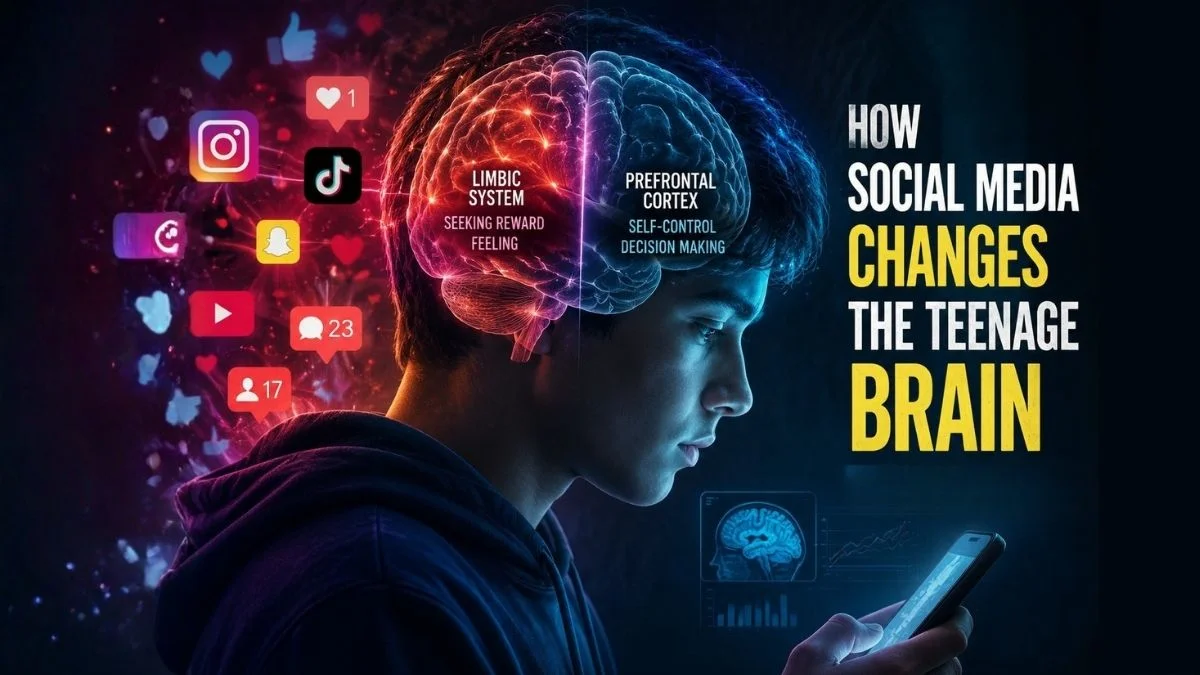
You’ve probably heard that social media is bad for teenagers. But most of that conversation stays at the surface — likes, comparison, anxiety. What’s happening underneath is more fundamental and more fascinating. Neuroscience is now showing us that social media isn’t just affecting how teenagers feel. It may be physically changing how their brains develop.
This is not speculation. Over the past three years, researchers using brain-imaging technology on thousands of adolescents have produced some of the most detailed evidence yet of how social media use interacts with the developing brain. This article explains what they’ve found — clearly, honestly, and without exaggerating what the science does and doesn’t yet know.
Why the Teenage Brain Is Uniquely Vulnerable
To understand how social media affects the teenage brain, you first need to understand what makes the teenage brain different from an adult’s. The difference is larger than most people realize.
The adolescent brain is not a smaller version of an adult brain — it is a brain in active, dramatic reconstruction. Two systems are particularly important:
| Brain System | What It Does | Development Status in Teens |
| Limbic System (Reward & Emotion) | Processes emotions, social rewards, fear, pleasure — the feeling brain | Develops EARLY — highly active and sensitive in adolescence |
| Prefrontal Cortex (Control) | Regulates impulses, weighs consequences, makes long-term decisions — the thinking brain | Develops LAST — not fully mature until mid-to-late 20s |
This developmental gap — a supercharged emotional system paired with an underdeveloped control system — is why teenagers are more impulsive, more sensitive to social reward and rejection, more influenced by peer opinion, and more reactive to emotionally charged content than adults. It is biology, not character.
Social media platforms were designed by adults with fully developed brains, tested primarily on adults, and then deployed into the hands of teenagers whose brains are specifically built to be highly responsive to exactly what social media delivers: social approval, peer comparison, novelty, and emotional stimulation.
The age at which a child first gets a smartphone matters here too — brain development and early smartphone use is something every parent should understand before making that decision.
Social Media and the Dopamine Reward System
Every time a teenager’s post receives a like, a comment, or a share, the brain’s reward circuit releases dopamine — the same neurotransmitter involved in the pleasure response to food, exercise, and in more extreme cases, addictive substances. This is not metaphorical. It is a documented neurological process.
A landmark study from UCLA, published in the journal Psychological Science, used fMRI brain imaging to watch the brains of teenagers as they looked at photos with many likes versus few likes. The nucleus accumbens — the brain’s core reward center — lit up significantly more in response to high-like photos, and teenagers were more likely to like a photo themselves if it already had many likes, regardless of its content. The social proof of peer approval directly activated the same brain circuitry involved in addiction.
Source: Sherman, L.E., et al. (2016). The Power of the Like in Adolescence. Psychological Science. UCLA Semel Institute.
The problem is not that dopamine is released — dopamine is essential. The problem is the frequency, unpredictability, and low threshold of the trigger. Social media delivers micro-rewards constantly and unpredictably — a notification here, a comment there, a viral moment that wasn’t expected. This variable reward pattern is neurologically the most addictive possible delivery mechanism, and the teenage brain is specifically primed to respond to it more intensely than an adult brain.
This same dopamine loop is engineered into video games too — our guide on how apps exploit the dopamine reward system in gaming explains exactly how it works and what the warning signs look like.
| Why Likes Hit Differently for Teens: In adults, the prefrontal cortex can moderate the emotional impact of social feedback — putting it in perspective, managing the response. In teenagers, the prefrontal cortex is still developing, which means the limbic system’s response to social reward and rejection goes relatively unmoderated. A negative comment or a low-liked post can feel neurologically catastrophic to a 13-year-old in a way that is not an overreaction — it is a reflection of how their brain is literally wired at that stage of development. |
New Research: Is Social Media Physically Changing the Teen Brain?
The most significant development in this field in the past two years is research showing not just functional changes in how the teen brain responds to social media, but structural changes in the brain itself.
The ABCD Study — Largest Brain Imaging Study of Children Ever Conducted
The Adolescent Brain Cognitive Development (ABCD) Study, funded by the National Institutes of Health and tracking over 12,000 children from ages 9–10 through adolescence, has produced some of the most important findings in this area.
A March 2026 analysis published in the journal NeuroImage found that greater social media use in early adolescents was associated with lower cortical thickness in several key brain regions, including areas of the Default Mode Network (DMN) — the network associated with self-referential thought, identity formation, and resting-state brain activity. Prior research has linked DMN thickness to general intelligence in young adults, and disruptions to its development have been connected to adolescent psychopathology.
In plain language: higher social media use was associated with measurably thinner brain tissue in regions involved in how teenagers think about themselves and process their identity. The long-term clinical implications are not yet fully clear — researchers are careful to note this. But the association is present, significant, and consistent with other findings.
Source: Social media use and early adolescent brain structure: Findings from the ABCD Study. NeuroImage, March 2026. ScienceDirect / PMC.
The Habitual Checking Study — JAMA Pediatrics, 2023
A study published in JAMA Pediatrics tracked 169 sixth and seventh graders over three years using brain imaging. Researchers from the University of North Carolina found that adolescents who habitually checked social media at age 12 showed greater brain sensitivity to social rewards and punishments at ages 13 and 15 — regardless of whether those rewards were positive or negative.
The study found two things: first, that social media checking behavior at 12 predicted measurable changes in brain sensitivity two to three years later; and second, that the more socially sensitive these teens’ brains became, the more they checked social media — creating a self-reinforcing cycle. The behavior was changing the brain, and the changed brain was driving more of the behavior.
Source: Maza, M.T., et al. (2023). Association of habitual checking behaviors on social media with longitudinal functional brain development. JAMA Pediatrics, 177(2), 160–167.
Addiction-Like Brain Changes — Social Cognitive and Affective Neuroscience, 2024
A 2024 study from Eva Telzer’s lab at the University of North Carolina, published in Social Cognitive and Affective Neuroscience, found that adolescents who showed addiction-like social media use had distinct patterns of brain function in reward and self-regulation regions — and that these patterns predicted more addiction-like use two years later.
Source: Developmental changes in brain function linked with addiction-like social media use two years later. Social Cognitive and Affective Neuroscience, 19(1), 2024. Telzer Lab, UNC.
| What the Science Does NOT Yet Prove: Neuroscience is finding clear associations between social media use and changes in the teen brain. What it has not yet been established with certainty is causation at the individual level — whether social media causes the brain changes, or whether teenagers with certain brain profiles are more drawn to heavy social media use in the first place. The evidence is strong enough to warrant serious concern and precaution. It is not yet strong enough to say definitively that social media use causes permanent brain damage in all teenagers. |
What’s Actually Happening: Four Documented Effects
1. Disrupted Attention and Focus
The rapid-fire, short-form content of social media — TikTok Reels, Instagram Stories, YouTube Shorts — trains the brain to expect constant novelty and stimulation. A 2025 peer-reviewed review published in Cureus (NIH/PMC) found that prolonged social media use alters the brain’s attention networks, reducing tolerance for sustained focus and increasing preference for short, high-stimulation inputs. This has direct implications for academic performance and the ability to engage in deep reading or complex problem-solving.
2. Heightened Social Sensitivity and Anxiety
Neuroscience research consistently shows that adolescents who use social media heavily develop greater sensitivity to social evaluation — both positive and negative. The brain regions responsible for processing social rejection show heightened reactivity. For teenagers already navigating the social complexity of adolescence, this neurological amplification of social feedback can fuel anxiety, social comparison, and in vulnerable individuals, depression.
Nature Communications published a review in 2024 noting that adolescents are highly sensitive to acceptance and rejection through social media, and that their heightened emotional sensitivity and protracted development of cognitive control make them specifically reactive to emotionally arousing content — more so than any other age group.
Source: Media use and brain development during adolescence. Nature Communications, 2024. Open access.
For a platform-specific look at how these effects play out day-to-day, read our deep dive on the mental health effects of Instagram on teens — including what Instagram’s own research found.
3. Sleep Disruption and Its Brain Consequences
The relationship between social media, sleep, and the developing brain is particularly well-established. Blue light suppresses melatonin; emotionally stimulating content activates the nervous system; and the social anxiety of checking notifications creates hyperarousal incompatible with sleep. The ABCD Study data consistently shows associations between heavy screen time and sleep disruption, and poor sleep in adolescence has its own documented effects on brain development — impairing memory consolidation, emotional regulation, and cognitive function.
4. Identity and Self-Worth Tied to External Validation
Perhaps the most subtle and lasting effect involves identity development. Adolescence is the primary period for developing a stable sense of self. Social media introduces a quantified, peer-evaluated version of the self — expressed in posts, likes, and follower counts. Research suggests that teenagers who heavily rely on social media feedback for self-evaluation show less internally stable self-worth — their sense of value fluctuates with engagement metrics rather than growing from within.
Is Any of This Good News?
Honest neuroscience reporting requires acknowledging what the research does not show. Not all social media use is equally harmful, and the picture is more nuanced than a simple negative verdict.
Yale School of Medicine researchers presenting early findings in March 2026 emphasized that associations between social media and brain changes vary significantly by how platforms are used, what type of content is consumed, and the individual teenager’s baseline mental health and social context. Video chatting, for example — two-way social connection — showed very different brain associations than passive scrolling.
The National Academies of Sciences, Engineering, and Medicine’s 2024 comprehensive report on social media and adolescent health acknowledged both harms and potential benefits — including access to supportive communities, creative expression, and connection for isolated youth — while calling for more research and stronger platform accountability.
What Parents Can Do With This Information
Neuroscience is not destiny. The teenage brain is also characterized by extraordinary plasticity — it changes in response to experience, which means the effects of social media use are not necessarily permanent, and healthy habits can build healthy brains.
- Delay and limit: The research supports delaying social media access and limiting daily use — not because screens are evil, but because the developing brain is specifically vulnerable during early adolescence. Every year of delay reduces the window of highest neurological sensitivity.
- Prioritize sleep above all: Sleep is when the adolescent brain consolidates learning, regulates emotion, and repairs itself. No-device bedrooms and a consistent digital curfew are among the highest-impact interventions a parent can make.
- Offline social time matters neurologically: In-person social interaction activates brain regions in ways that screen-based interaction does not. Sports, clubs, face-to-face friendships, and family connection all support healthy brain development in ways that complement or partially buffer social media exposure.
- Teach what’s happening: Teenagers who understand how dopamine loops work, how algorithms exploit reward circuits, and why likes feel so significant are meaningfully better equipped to use platforms intentionally rather than compulsively.
- Watch for the signs: Persistent mood that fluctuates with social media engagement, inability to sustain attention on non-stimulating tasks, sleep disruption, and social withdrawal are all behavioral signals worth taking seriously in the context of this research.
The Bottom Line
The teenage brain is not just an adult brain in a smaller body. It is a brain in a specific and sensitive phase of development — one that is neurologically primed to seek social reward, respond intensely to peer feedback, and form habits easily. Social media platforms are engineered to exploit exactly these characteristics.
The neuroscience emerging from studies like ABCD and the work of researchers like Eva Telzer is revealing that the effects go beyond mood and self-esteem — there are measurable, structural associations between heavy social media use and changes in how the adolescent brain develops. The full story is not yet written, and the science continues to evolve.
What is clear enough to act on: the earlier and heavier the exposure, the greater the likely impact. And the most protective things a parent can offer — delayed access, sleep, offline connection, and open conversation — are the same things that support healthy brain development, whether social media existed or not.
References & Further Reading
Sherman, L.E., et al. (2016). The Power of the Like in Adolescence: Effects of Peer Influence on Neural and Behavioral Responses to Social Media. Psychological Science. UCLA.
Maza, M.T., et al. (2023). Association of habitual checking behaviors on social media with longitudinal functional brain development. JAMA Pediatrics, 177(2), 160–167.
Telzer, E.H., et al. (2024). Developmental changes in brain function linked with addiction-like social media use two years later. Social Cognitive and Affective Neuroscience, 19(1), nsae008.
Social media use and early adolescent brain structure: Findings from the ABCD Study. NeuroImage, March 2026.
De, D., et al. (2025). Social Media Algorithms and Teen Addiction: Neurophysiological Impact and Ethical Considerations. Cureus. PMC11804976.
Media use and brain development during adolescence. Nature Communications, 2024. Open access.
Yale School of Medicine (March 2026). Social Media and Youth Mental Health: Does More Use Always Mean More Harm? medicine.yale.edu
National Academies of Sciences, Engineering, and Medicine (2024). Social Media and Adolescent Health. nationalacademies.org