
📋 Research-Based Guide
This guide is built from the official age certificate and its published rating reason, together with the trailer and released material. We have not screened this title ourselves, and we will not describe scenes we have not seen. We are working through our back catalogue and upgrading guides to Verified as fast as we can genuinely watch them. How we rate →
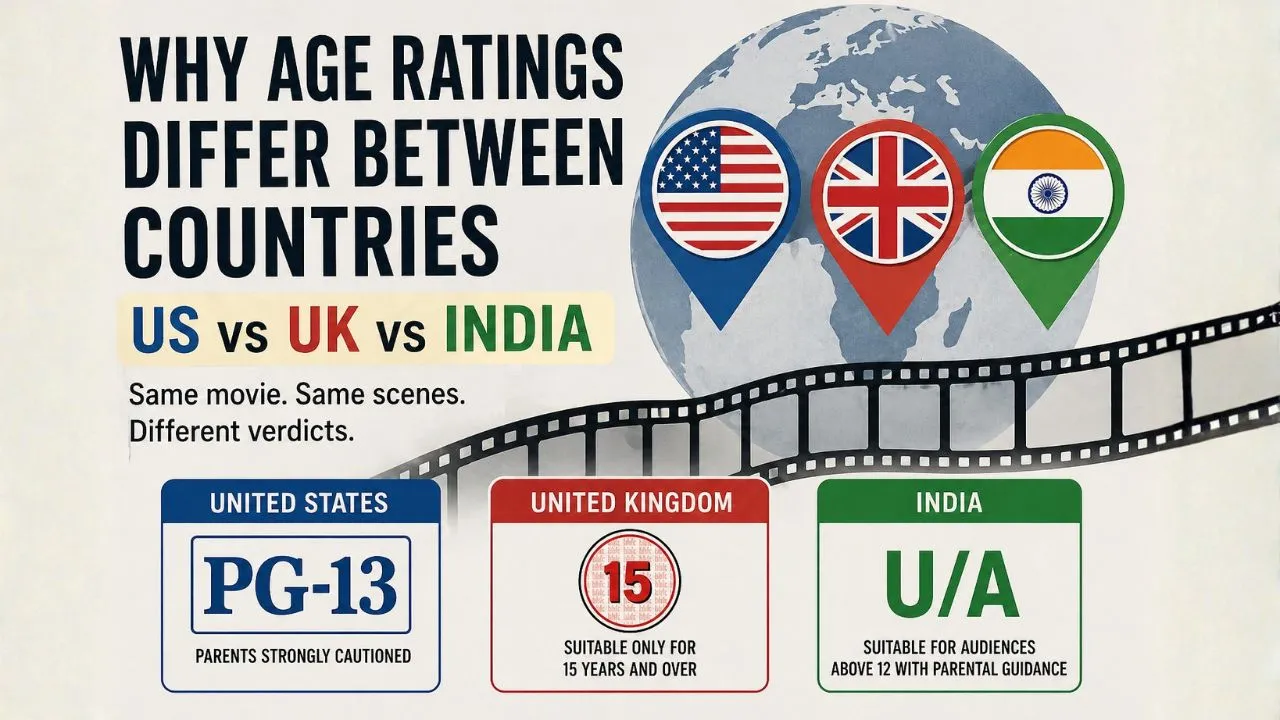
Picture this: a blockbuster action film hits theaters worldwide on the same day. In the United States, it’s rated PG-13. In the United Kingdom, it walks out with a 15 certificate. Meanwhile, in India, the Central Board of Film Certification stamps it with a U/A — suitable for audiences above 12 with parental guidance. Same movie. Same scenes. Three very different verdicts.
If you’ve ever scratched your head wondering why a film your child’s friends watched in London is somehow restricted in Mumbai, or why a show labeled TV-MA in America turns up as a 15 on Netflix UK — you’re not alone. This is one of the most common questions parents face in the streaming age, and the answer is genuinely fascinating.
Age rating systems are not just bureaucratic labels slapped on content. They are windows into what each society considers appropriate, harmful, or acceptable for its children — and those windows look very different depending on where you are in the world. Cultural values, political history, religious influences, legal frameworks, and even attitudes toward nudity, violence, and language all shape how a country rates its media.
In this guide, we’re taking a deep, honest look at three of the world’s major rating systems — the United States, the United Kingdom, and India — and explaining exactly why the same content can carry such different labels depending on which side of the border you’re on.
Why Age Rating Systems Exist in the First Place
Before we compare the systems, it’s worth understanding what they’re trying to do. Age rating systems emerged in the 20th century as a response to the growing power of mass media — first film, then television, and now streaming — to shape attitudes, behaviors, and emotional responses, particularly in children.
Every country that has developed a rating system shares a common concern: not all content is appropriate for all audiences, and children deserve some protection from material that might harm their development, disturb them psychologically, or expose them to values or imagery they aren’t equipped to process.
Where countries diverge — sharply and fascinatingly — is in what they consider harmful. That divergence is cultural, political, and deeply human.
| 🌍 The Core Question Every Rating System Tries to Answer:What content is too mature, too disturbing, too explicit, or too dangerous for children — and at what age does that protection lift? The answers differ dramatically by country, and understanding why tells you a great deal about each society’s values. |
The United States: The MPAA and TV Ratings System
The United States film rating system is managed by the Classification and Rating Administration (CARA), a division of the Motion Picture Association (MPA, formerly MPAA). It was established in 1968 under Jack Valenti, replacing the old Hays Code — a strict, censorship-based system that had governed Hollywood since the 1930s.
The shift was significant. Instead of censoring content, the new system adopted a classification model: films could contain almost anything, as long as they were properly labeled so audiences could make informed choices. This philosophy — information over prohibition — has defined the American approach ever since.
The MPAA Film Ratings Explained
| Rating | Full Name | What It Means |
| G | General Audiences | All ages admitted. Nothing offensive. Suitable for children without parental concern. |
| PG | Parental Guidance Suggested | Some material may not be suitable for children. Parents urged to investigate. |
| PG-13 | Parents Strongly Cautioned | Some material may be inappropriate for children under 13. Strong caution advised. |
| R | Restricted | Under 17 requires accompanying parent or adult guardian. |
| NC-17 | Adults Only | No one 17 and under admitted. Explicit content not appropriate for minors. |
The PG-13 rating was introduced in 1984, partly in response to public outcry over intense content in PG-rated films like Indiana Jones and the Temple of Doom and Gremlins — both directed by Steven Spielberg, who himself suggested the new category. It has since become the most commercially valuable rating in Hollywood, as it allows studios to reach the widest possible audience.
The US TV Rating System
Television in the US operates under a separate but parallel system, developed in 1997 following the Telecommunications Act of 1996. TV ratings are displayed in the corner of the screen at the start of a program.
| TV Rating | Intended Audience |
| TV-Y | All children, including ages 2–6 |
| TV-Y7 | Children 7 and older; may include mild fantasy violence |
| TV-G | General audience; suitable for all ages |
| TV-PG | Parental guidance suggested; may include mild content |
| TV-14 | Parents strongly cautioned; unsuitable for children under 14 |
| TV-MA | Mature audiences only; not suitable for under 17 |
What Makes the US System Unique
The American system has some deeply distinctive cultural fingerprints. Most notably, US ratings are far more tolerant of violence than of sexual content or nudity. A film can show intense combat, explosions, and significant physical harm at the PG-13 level — but a brief scene of non-sexual nudity can tip a film into R territory.
This has been a source of ongoing cultural debate. Critics argue the system sends a contradictory message to children: that seeing a gun used to harm people is more acceptable than seeing the human body. Defenders of the system argue it reflects genuine parental concern and cultural values around modesty and sexuality.
Language is another defining feature. A single use of a particular expletive (specifically, the F-word used in a sexual context) can trigger a PG-13 rating. Two uses almost certainly mean an R. This level of specificity around language is far more pronounced in the US system than in its British or Indian counterparts.
Reference: Motion Picture Association. (2023). Classification and Rating Rules. motionpictures.org/film-ratings
The United Kingdom: The BBFC System
The British Board of Film Classification (BBFC) was founded in 1912 — more than half a century before the American MPAA system — making it one of the oldest film classification bodies in the world. Originally established by the film industry itself to pre-empt government censorship, it has evolved over a century into a nuanced, research-driven classification body.
Unlike the MPAA, the BBFC is a statutory authority for video and DVD content under the Video Recordings Act 1984, meaning its classifications carry legal weight for home media. For cinema releases, its classifications are legally enforced by local councils, though in practice they follow BBFC guidance universally.
BBFC Film & Video Ratings Explained
| Rating | Full Name | What It Means |
| U | Universal | Suitable for all. A U film should be suitable for audiences aged four and over. |
| PG | Parental Guidance | General viewing, but some scenes may be unsuitable for young children. |
| 12A | 12A (Cinema) | Suitable for 12 years and over. Under 12s may watch with accompanying adult. |
| 12 | 12 (Home Media) | Suitable for 12 years and over. Not to be supplied to anyone below that age. |
| 15 | 15 | Suitable only for 15 years and over. Not to be supplied to anyone below that age. |
| 18 | 18 | Suitable only for adults. Not to be supplied to anyone below that age. |
| R18 | Restricted 18 | Adult works for licensed venues or sex shops only. Explicit sexual content. |
What Makes the UK System Unique
The BBFC’s approach is notable for its transparency and depth of research. The board publishes detailed classification guidelines every four to five years, informed by extensive public consultation — surveying thousands of British adults and children to understand what the public considers acceptable at each age level. This makes it one of the most democratically grounded systems in the world.
In stark contrast to the United States, the UK system tends to be more tolerant of nudity and mild sexual content, but more restrictive around certain types of violence — particularly violence that might be instructional (showing how to inflict harm) or sadistic in nature. A film showing natural non-sexual nudity, for instance, is unlikely to receive a rating above 12A in the UK, whereas the same content might earn an R in the US.
Drug use is handled with particular nuance. The BBFC distinguishes between references to drug use, depictions of drug use without glamorization, and content that might instruct or encourage drug use. A film showing a character smoking cannabis without consequence might receive a 15, whereas the same content with clear negative consequences might remain at 12A.
The 12A certificate — introduced in 2002 specifically for the film Spider-Man, whose content fell awkwardly between a PG and a 12 — is a uniquely British solution: it allows younger children to watch borderline content if a parent or guardian accompanies them and takes responsibility for the viewing decision.
Reference: British Board of Film Classification. (2023). BBFC Classification Guidelines. bbfc.co.uk/about-classification/classification-guidelines
India: The CBFC System
India’s film classification system is managed by the Central Board of Film Certification (CBFC), a statutory body operating under the Cinematograph Act of 1952 — one of the earliest film regulation laws in any democracy. The CBFC, commonly known as the Censor Board, is appointed by and accountable to the Ministry of Information and Broadcasting of the Government of India.
Unlike the MPAA and BBFC, the CBFC has historically operated with a mandate that goes beyond classification into active censorship — meaning it has the authority to demand cuts, modifications, or outright bans on films before they can be released in Indian cinemas. This gives the Indian system significantly more regulatory power than its Western counterparts.
CBFC Film Ratings Explained
| Rating | Full Name | What It Means |
| U | Unrestricted Public Exhibition | Suitable for all audiences, including children. No restrictions. |
| UA 7+ | Parental Guidance for ages below 7 | Suitable for all, with parental guidance for children under 7. |
| UA 13+ | Parental Guidance for ages below 13 | Suitable for audiences 13 and above; parental guidance for younger children. |
| UA 16+ | Parental Guidance for ages below 16 | Suitable for audiences 16 and above; parental guidance for younger. |
| A | Restricted to Adults | For adults only (18+). Not for children under any circumstances. |
| S | Restricted to Specialised Audiences | Only for specific professional audiences (e.g., medical, scientific). |
| 📌 Important Update:In 2023, the CBFC introduced a revised rating framework replacing the older single U/A category with three sub-categories: UA 7+, UA 13+, and UA 16+. This update brought India’s system closer in granularity to international standards. These ratings are now used for films certified from 2023 onwards. |
What Makes the Indian System Unique
The CBFC operates in one of the world’s most culturally and linguistically diverse countries, and that diversity shapes its approach in complex ways. India has 28 states and 8 union territories, numerous religious communities, and deeply varied regional sensibilities — all of which the CBFC must navigate.
The board applies particularly stringent standards around content that could be seen as disrespectful to religion, national symbols, or cultural traditions. Content mocking religious practices, depicting certain deities in ways deemed offensive, or showing the national flag or national anthem disrespectfully can result in mandatory cuts regardless of the overall rating.
Sexual content faces some of the strictest restrictions of any major rating system. While violence — particularly in the context of action films or mythological epics — is often permitted at the U/A level, even mildly suggestive romantic content is frequently edited before certification. Kissing scenes, for instance, have historically been cut from films receiving U certificates, though standards have gradually relaxed in recent years.
Political sensitivity is also a significant factor. Films touching on topics related to national security, historical conflicts, or political figures can face lengthy delays or demands for substantial changes. This is an aspect of Indian film regulation that has no direct equivalent in the UK or US systems, where government interference in content certification is constitutionally far more constrained.
OTT platforms (Netflix, Amazon Prime, Disney+ Hotstar, etc.) in India operate under the Information Technology (Intermediary Guidelines and Digital Media Ethics Code) Rules, 2021, which introduced a separate self-regulation framework for digital content — meaning streaming content and theatrical content follow different certification paths.
Reference: Central Board of Film Certification, Government of India. cbfcindia.gov.in | Ministry of Information & Broadcasting. mib.gov.in
Side-by-Side: How the Three Systems Compare
| Factor | USA (MPA/CARA) | UK (BBFC) | India (CBFC) |
| Governing Body | Private industry body (MPA) | Independent statutory authority | Government statutory body |
| Legal Authority | Voluntary (enforced by theaters) | Legally binding for home media | Legally binding; can mandate cuts |
| Founded | 1968 (current system) | 1912 | 1952 |
| Violence Tolerance | High — moderate violence at PG-13 | Moderate — context-sensitive | Moderate-High — action violence common |
| Sexual Content | Very restrictive — even mild nudity can mean R | More permissive — nudity at 12A possible | Very restrictive — strong censorship |
| Language / Profanity | Highly specific rules on language | Context-based, less rigid | Strict — profanity often cut |
| Religious Sensitivity | Low regulation | Low regulation | Very high — protected category |
| Drug Use Depiction | Moderate concern, context-based | Nuanced — harm context matters | Generally restricted or cut |
| Government Interference | None — industry self-regulation | Independent of government | High — government-appointed board |
| OTT / Streaming | Platforms self-rate (TV Parental Guidelines) | BBFC rates some OTT content (Netflix UK) | Separate IT Rules 2021 framework |
Real-World Examples: Same Film, Different Ratings
Nothing illustrates the differences more clearly than real films that received different ratings in each country. Here are some documented examples:
The Dark Knight (2008)
- USA: PG-13 — for intense sequences of violence and some menace.
- UK: 12A — sustained threat and menace, scenes of violence, some disturbing images.
- India: UA — suitable for general audiences with parental guidance.
The Joker’s psychological menace and the film’s themes of urban chaos were weighed differently across each board. The UK’s 12A reflected concern about sustained threat; the US PG-13 allowed it for the older teen demographic; India’s UA acknowledged the intensity while keeping it accessible with guidance.
Deadpool (2016)
- USA: R — strong violence, language throughout, sexual content, and graphic nudity.
- UK: 15 — strong bloody violence, strong language, sex references.
- India: A — adults only, following mandatory cuts to some scenes.
This is a clear example of broadly aligned decisions between the US and UK, with India taking the most restrictive stance due to sexual content and language that fell outside CBFC’s permissible range even after cuts.
Barbie (2023)
- USA: PG-13 — suggestive references and brief language.
- UK: 12A — moderate sex references, mild bad language.
- India: U/A 13+ — under the updated framework, due to thematic content.
A relatively consistent set of decisions across all three countries, reflecting the film’s playful but adult-themed content around identity, feminism, and existential humor.
What About Streaming Platforms? Does It Get Even More Complicated?
Yes — and this is increasingly relevant for parents. Streaming platforms like Netflix, Amazon Prime Video, Disney+, and Apple TV+ operate globally but must comply with local regulations wherever they operate. This creates a patchwork of different rating labels for the same content depending on where you access it.
Netflix, for example, uses local rating systems in each country. A show rated TV-MA in the US might appear as 18 in the UK or A in India. The same show. The same content. Rated by different bodies with different standards.
To further complicate things, Netflix applies BBFC ratings in the UK only for content the BBFC has actually certified. For content the BBFC hasn’t rated, Netflix uses its own internal rating system — which applies a different methodology. This means the 15 or 18 badge you see on some Netflix UK content may be BBFC-certified, while others carry Netflix’s own assessment.
In India, the IT Rules 2021 require OTT platforms to self-classify content using a five-category system: U, U/A 7+, U/A 13+, U/A 16+, and A. Platforms must also make parental controls available and provide content descriptors (violence, language, sex, etc.) for each title. The framework is relatively new and enforcement is still evolving.
| 💡 Practical Tip for Parents:When using any streaming platform, don’t rely solely on the rating badge. Look for the content descriptors beneath the rating — they tell you specifically what type of content earned the rating: violence, language, sexual content, drug references, etc. These descriptors are more useful than the rating alone. |
Why This Matters for Parents Specifically
Understanding rating systems across countries has become a practical necessity for modern parents — not just an academic curiosity. Here’s why:
- Streaming has erased borders: Your child can access content rated for any country on a global platform. A show that would never make the cut for Indian screens can appear on an OTT platform with a U/A 13+ label and be one click away on a shared family account.
- Ratings are not universal safety guarantees: A UK 12A means a 10-year-old can watch a film in a cinema with a parent. In the US, that same parent might be surprised to find the film is PG-13. Neither rating tells you whether the specific content is right for your specific child.
- Cultural context matters: A film that earns a 15 in the UK for ‘strong language’ might only earn a PG-13 in the US where that language is common. An Indian film rated U might contain mythological violence that a Western board might rate PG. Always read content descriptors, not just the letter or number.
- OTT platforms blur the lines further: Algorithmic recommendations don’t respect rating boundaries. A child who watches a U/A 13+ show on an Indian streaming app may find a very different U/A 13+ show recommended next — because the algorithm optimizes for engagement, not consistent content appropriateness.
FAQs
Q: Why do age ratings differ between countries?
A: Age ratings differ because each country has its own cultural values, legal systems, and social norms. What is acceptable for children in one country—such as violence, language, or nudity—may be viewed very differently in another.
Q: Why is a PG-13 rating in the US different from a 12A in the UK?
A: A PG-13 rating in the US and a 12A in the UK are similar but not identical. The US system is stricter about sexual content and language, while the UK is more tolerant of mild nudity but more cautious about certain types of violence.
Q: Why is India stricter with movie ratings than the US or UK?
A: India’s system, managed by the CBFC, includes censorship powers. It is stricter due to cultural diversity, religious sensitivity, and government regulations, especially around sexual content, religion, and political themes.
Q: What does U/A mean in Indian film ratings?
A: U/A means “Unrestricted Public Exhibition with Parental Guidance.” It allows children to watch content with supervision. The updated system includes U/A 7+, U/A 13+, and U/A 16+.
Q: Are Netflix and OTT platform ratings the same worldwide?
A: No, streaming platforms use different rating systems depending on the country. The same show can have different ratings in the US, UK, and India based on local standards.
Q: Can the same movie have different ratings in different countries?
A: Yes, the same movie often receives different ratings worldwide because each country evaluates content using its own guidelines for violence, language, sexual content, and cultural sensitivity.
Q: Which country is stricter about sexual content in movies?
A: The US and India are generally stricter than the UK. India, in particular, often requires edits or cuts before approving such content.
Q: Which country is more lenient about violence in films?
A: The United States tends to be more lenient about violence, especially at the PG-13 level, while the UK and India are more context-sensitive.
Q: Should parents rely only on age ratings?
A: No, ratings are only a guideline. Parents should also check content descriptors and, if possible, preview content before allowing children to watch.
Q: Why do streaming recommendations ignore age differences?
A: Streaming algorithms prioritize engagement, not age appropriateness. This can lead to very different types of content being recommended under the same rating category.