
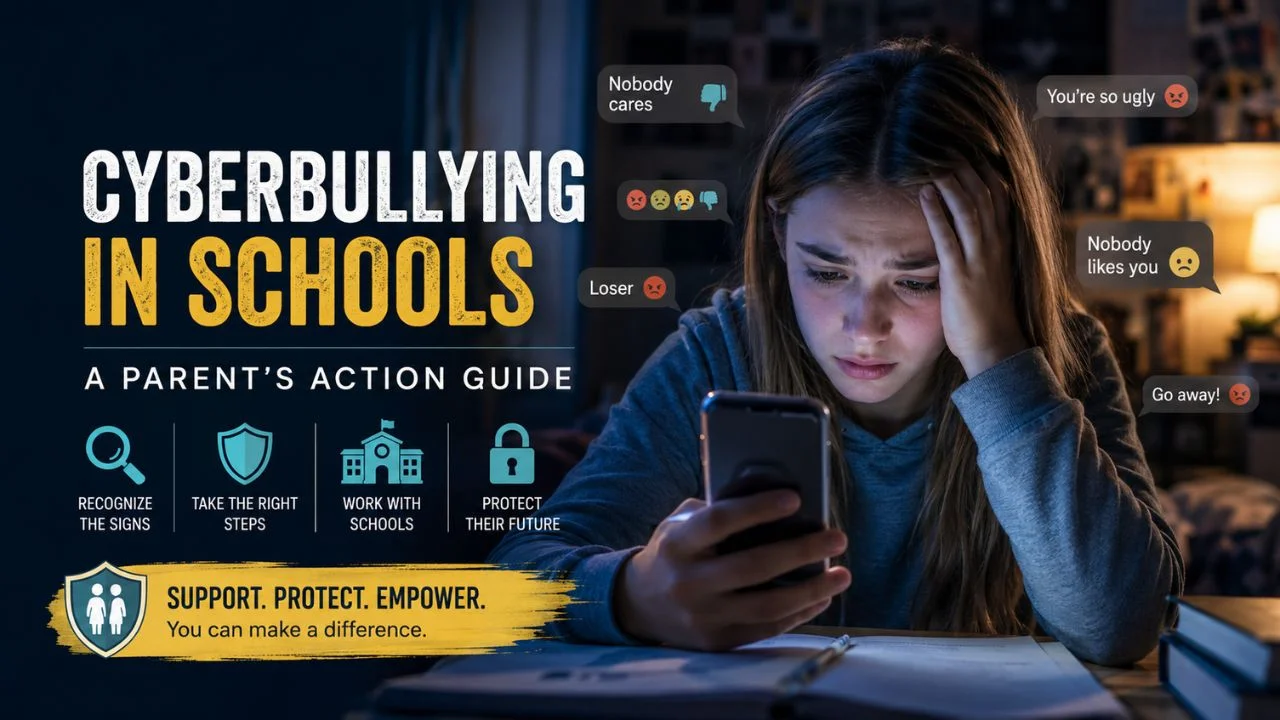
It Doesn’t Stop When the School Bell Rings
That is what makes cyberbullying fundamentally different from the bullying most parents experienced growing up. Traditional bullying happened at school and ended when your child came home. Cyberbullying follows them through the front door, into the kitchen, up to their bedroom, and onto the screen they look at right before they go to sleep.
Between 2016 and 2025, lifetime cyberbullying victimization among young people rose from 33.6% to 58.2%. In the most recent major study, 26.5% of students reported experiencing cyberbullying in the previous 30 days alone — up from 23.2% in 2021, 17.2% in 2019, and 16.7% in 2016. The trend line is not ambiguous. This is not a niche problem. It is, statistically, something that will touch your child’s life — or already has.
This guide gives you the complete action framework: how to recognize it, what to do if your child is a victim, how to handle it with the school, what the law says, and how to protect your child going forward.
What Cyberbullying Actually Is — and What It Isn’t
Not every conflict online is cyberbullying. Understanding the distinction helps parents respond proportionately.
Cyberbullying is repeated, intentional harmful behavior carried out through digital technology — phones, social media, gaming platforms, messaging apps — that involves a power imbalance between the person doing it and the target.
It includes:
- Sending threatening, humiliating, or harassing messages repeatedly
- Spreading rumors or sharing private information online without consent
- Exclusion from online group chats or communities as a deliberate social punishment
- Creating fake profiles to impersonate or mock someone
- Sharing or threatening to share private photos or videos
- Coordinated harassment — organizing a group to attack a single target
The most commonly reported forms in 2024: mean or hurtful comments posted online (30.4%), exclusion from group chats (28.9%), rumors spread online (28.4%), and someone humiliating them online (26.9%).
Not cyberbullying: A one-time argument. A friend falling out. Someone saying something unkind once. These are unpleasant but do not meet the threshold of cyberbullying — and treating them identically muddies the response and can actually reduce the seriousness of genuine cases.
Who Is Most at Risk?
Cyberbullying affects children of all ages and backgrounds — but the data identifies specific groups at higher risk:
- Adolescent girls are more likely to have experienced cyberbullying in their lifetimes (59.2% female vs 49.5% male). Girls are more likely to experience rumors spread about them online; boys are more likely to experience online threats of physical harm.
- LGBQ+ students experience cyberbullying at twice the rate of their heterosexual peers (27% vs 13%). As of 2021, 35% of transgender youth aged 13–17 reported being cyberbullied.
- Black teens in the US are approximately twice as likely as white or Hispanic teens to report being cyberbullied due to their race or ethnicity.
- Children with anxiety, social difficulties, or who are already socially isolated offline tend to be targeted at higher rates
- Middle schools show the highest rates — 37% of middle schools reported cyberbullying occurring at least once a week, compared to 25% of high schools.
Warning Signs Your Child Is Being Cyberbullied
Most children do not tell their parents. Two-thirds of teenagers who experienced cyberbullying said it affected their ability to learn and feel safe at school — yet many suffer in silence. Watch for these behavioral signals:
Online behavior changes:
- Becomes visibly upset, anxious, or angry after using their phone or device
- Stops using devices or apps they previously enjoyed — or conversely, becomes obsessed with checking them
- Closes screens quickly or becomes secretive when you approach
- Uses devices at unusual hours — late at night, or avoids them entirely
Offline behavior changes:
- Withdrawal from friends, family, and activities they previously enjoyed
- Unexplained drops in academic performance
- Reluctance or refusal to go to school
- Changes in mood, sleep patterns, eating habits
- Making comments that suggest low self-worth or hopelessness
Physical signals:
- Stomachaches or headaches before school with no clear cause
- General restlessness, anxiety, or tearfulness without explanation
Cyberbullying victims are four times more likely to engage in self-harm or suicidal behavior than non-victims. If your child is showing signs of significant distress — particularly hopelessness, withdrawal from all activities, or any mention of self-harm — treat this as a mental health priority, not just a bullying incident.
For guidance on recognizing serious mental health signals in teenagers, see our article on how social media changes the teenage brain — what neuroscience says.
Step-by-Step: What to Do If Your Child Is Being Cyberbullied
Step 1 — Listen First, React Second
Your child’s first need when they disclose cyberbullying is to feel believed and supported — not to have the problem immediately solved or to have you tell them what they should have done differently. Resist the impulse to react with alarm, anger, or immediate action. Sit with them. Thank them for telling you. Ask open questions: “How long has this been happening?” “Who else knows?” “How are you feeling about it?”
The quality of this first conversation determines whether they come to you again in the future. If your response is overwhelming or feels like their fault, they will not tell you next time.
Step 2 — Do Not Delete Anything — Document Everything
Before taking any action, preserve the evidence. Screenshot everything — messages, posts, profile names, timestamps, and any context that makes clear the relationship and pattern. Reporting rates for cyberbullying remain low, and only a fraction of reports result in meaningful action — solid documentation significantly improves outcomes.
Save screenshots to a folder with dates. Note which platform, which accounts were involved, and the timeline. This documentation matters for school complaints, platform reports, and if it ever escalates to law enforcement.
Step 3 — Block and Report on the Platform
Every major platform — Instagram, Snapchat, TikTok, Discord, Roblox, YouTube — has block and report functions. Use both. Blocking prevents further contact; reporting triggers the platform’s moderation process. Most platforms will not share the outcome of their investigation with you, but reports contribute to patterns that lead to account removal.
Be aware: blocking does not always stop the bullying — a determined bully will create new accounts. Document any new contact from new accounts as part of the same pattern.
Step 4 — Contact the School
Many parents hesitate to involve the school because cyberbullying happened outside school hours. This is a misconception. Schools have both the authority and the responsibility to address cyberbullying even when it occurs off-campus, because it directly affects the school environment and your child’s ability to feel safe and learn.
Contact your child’s teacher, form tutor, or head of year first — not the bully’s parents directly. Direct parent-to-parent contact typically escalates rather than resolves the situation.
When you contact the school:
- Bring your documented evidence — screenshots, dates, platform names
- Request a meeting in writing (email) so there is a record
- Ask specifically what the school’s anti-bullying policy says about cyberbullying
- Ask what actions will be taken and within what timeframe
- Follow up in writing after any meeting to confirm what was agreed
If the school does not respond adequately, escalate to the headteacher or principal, then the district or local authority if necessary.
Step 5 — Consider Whether Law Enforcement Is Needed
Most cyberbullying does not require police involvement — but some situations do. Contact law enforcement if the bullying involves:
- Threats of physical harm or violence
- Sexual images — including AI-generated images used as threats
- Extortion or blackmail
- Stalking behavior across multiple platforms
- Content that may constitute a hate crime based on race, religion, sexuality, or disability
In the US, report to local police and the FBI’s Internet Crime Complaint Center (ic3.gov). In the UK, report to local police and CEOP (ceop.police.uk). In Canada, report to local police and the Canadian Centre for Child Protection (cybertip.ca).
Step 6 — Support Your Child’s Mental Health
The practical steps above address the situation. Your child’s emotional wellbeing requires separate, sustained attention.
- Check in regularly — not once, but over weeks and months
- Keep them connected to offline friendships, activities, and routines that reinforce their sense of worth outside the digital environment
- Consider whether professional support — a school counselor, a therapist, or a child psychologist — would help
- Be explicit with them: this is not their fault, it says nothing about their worth, and you are on their side
If Your Child Is the One Doing the Bullying
This is harder for most parents to consider — but it is essential to address honestly. On average, a quarter of children and teens have cyberbullied someone in the last five years.
If you discover your child has been bullying another child online:
- Do not dismiss, minimize, or defend the behavior
- Approach it as a teachable moment, not primarily a punishment opportunity
- Have a direct conversation about the impact of their actions on the target — research consistently shows that empathy-focused responses are more effective at changing behavior than punishment alone
- Involve the school proactively rather than waiting to be contacted
- Consider whether your child’s behavior reflects something they are struggling with — bullying behavior in children often has roots in their own difficulties
What the Law Says in 2026
Cyberbullying laws vary by country and US state, but legal protections have strengthened significantly in recent years:
United States: No single federal cyberbullying law, but 48 states have laws addressing cyberbullying or electronic harassment. Many include school jurisdiction over off-campus digital behavior. The TAKE IT DOWN Act (signed May 2025) specifically criminalizes non-consensual intimate image sharing including AI deepfakes — relevant where sextortion or image-based bullying is involved.
United Kingdom: Cyberbullying falls under several existing laws including the Malicious Communications Act 1988, Communications Act 2003, and Protection from Harassment Act 1997. The Online Safety Act 2023 requires platforms to remove harmful content faster and gives Ofcom enforcement powers. Schools are legally required under the Education Act to have anti-bullying policies that address cyberbullying.
Canada: Criminal Code provisions covering harassment, threats, and defamatory libel apply to cyberbullying cases. Several provinces have enacted specific cyberbullying legislation. Canada criminalized AI-generated harassment imagery in 2025.
Practical Prevention: Reducing the Risk Before It Happens
- Keep communication open — children who feel they can talk to parents without judgment are significantly more likely to report bullying early, before it escalates
- Set clear expectations about online behavior — be explicit that the same standards of respect apply online as offline, and that your family does not tolerate cruelty in either direction
- Know the platforms your child uses — you cannot respond effectively to bullying on a platform you don’t understand. Our platform safety guides cover Instagram, Snapchat, Discord, Roblox, and more
- Check in about their social life online — not as surveillance but as genuine interest. “Who are you playing with?” and “What’s happening in your group chat?” are not intrusive questions if they’re asked regularly in a warm context
- Teach what to do — make sure your child knows: screenshot, do not respond, block, tell a trusted adult. Rehearse this so it is automatic rather than something they have to figure out in distress
For the broader picture of online risks, our guide on online predators in 2026: how they find children and how to protect yours covers the threats that often intersect with cyberbullying.
Useful Resources
- Cyberbullying Research Center (US): cyberbullying.org — Dr. Justin Patchin and Dr. Sameer Hinduja’s research-based resources for parents
- StopBullying.gov (US): stopbullying.gov — federal government resource with state law database
- Childnet International (UK): childnet.com — UK-focused resources and school guides
- Kidscape (UK): kidscape.org.uk — support for bullied children and their families
- PACER’s National Bullying Prevention Center: pacer.org/bullying — extensive data and parent guides
- Crisis Text Line (US): Text HOME to 741741 — for children in immediate distress