
The Moment That Made You Google This
Maybe it was dinner. Everyone sat together, food on the table, and your child’s eyes kept drifting toward their phone. Or you suggested a family day out, and they asked if they could just stay home and play. Or you watched them light up during a video game in a way they haven’t lit up around actual people in months.
You’re not imagining it. And you’re not alone in noticing it.
The preference for screens over people is one of the most common concerns parents raise in 2026 — and understanding why it happens is the only way to address it meaningfully. Because the answer isn’t laziness, bad character, or a broken relationship, it is neurological, design-driven, and fixable.
Why Screens Win — The Honest Explanation
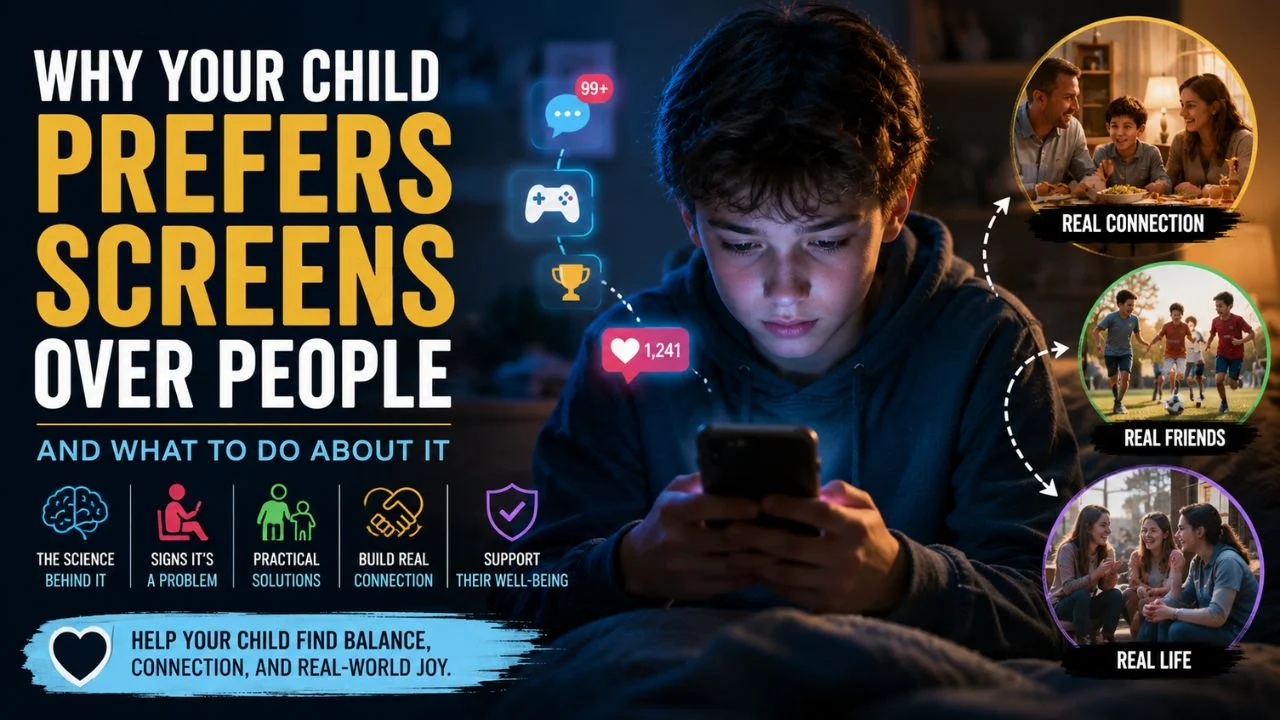
Here is the uncomfortable truth: for a child or teenager, screens are objectively easier than people, not in a moral sense — in a neurological one.
Real human interaction is demanding. It requires reading facial expressions, managing awkward silences, navigating conflict, tolerating rejection, and regulating emotions in real time without a pause button. These are genuinely hard cognitive and social tasks — especially for developing brains.
Screens offer something very different: a controlled, low-risk, high-reward social environment where your child is always in partial control of the interaction. They can mute, pause, log off, or simply not respond. The feedback is immediate and often positive. The dopamine hits are frequent and predictable.
Research published in ScienceDirect in October 2025 found that parental phubbing — where caregivers prioritize their own devices over direct engagement with their children — diminishes the quality of parent-child exchanges and increases children’s negative affect, undermining their social-emotional adjustment. In other words, the screen preference is not just about what screens offer. It is also shaped by what real-world interactions have started to feel like by comparison.
The Science: What’s Actually Happening in Your Child’s Brain
This is not simply a habit problem. There is a neurological explanation worth understanding.
Every time your child receives a notification, earns a reward in a game, gets a like on a post, or receives a message, their brain releases dopamine. The reward is immediate, predictable, and requires almost no emotional risk. Real-world social interaction, by contrast, requires effort with uncertain outcomes.
Over time, with enough screen exposure, the brain recalibrates. A 2024 meta-analysis published in ScienceDirect found that passive screen use — consuming content without meaningful interaction — moderates social-emotional development negatively, while active screen use (video calls, collaborative games, educational apps) can support it. The issue is not screens themselves — it is what kind of screen use is dominating.
When passive consumption dominates — scrolling, binge-watching, solo gaming — the brain is rewarded constantly without doing the emotional work that human connection requires. Real people start to feel effortful by comparison. Not because your child doesn’t love their family or want friends, but because their brain’s reward system has been recalibrated toward easier inputs.
Our article on how social media changes the teenage brain — what neuroscience says covers the dopamine and brain development science behind this in detail
What Age Is This Most Common — And Why
Screen preference over people shows up across age groups, but peaks at predictable developmental stages:
Ages 8–12: This is when gaming and YouTube become primary entertainment. Peer relationships become more complex and emotionally intense — and screens offer a retreat from that complexity. Children who struggle socially are especially likely to default to screens as a lower-stakes alternative.
Ages 13–16: Teenagers are developmentally wired to prioritize peer relationships — but those relationships now largely live on screens. Discord, Snapchat, Instagram, and gaming are where their social life happens. Preferring screens over family interaction at this age is partly developmentally normal — but becomes concerning when it extends to all offline interaction, including friends.
Any age with underlying anxiety: Socially anxious children are more likely to prefer screens across all ages because the reduced social demand of screen interaction feels genuinely safer. If your child’s screen preference is accompanied by significant anxiety around social situations, this is worth exploring with a professional.
Signs It Has Become a Problem — Not Just a Preference
There is a meaningful difference between a child who enjoys gaming and a child who is using screens to avoid the difficulty of human connection. Signs the latter may be happening:
- Genuine distress or irritability when required to participate in family or social activities
- Declining interest in friendships that previously mattered
- Difficulty sustaining eye contact or conversation with people they don’t know well
- Increased social awkwardness that seems to worsen over time rather than improve
- Using screens specifically after difficult social situations — as emotional regulation, not entertainment
- Stating explicitly that people are “too much effort” or that they prefer being alone
None of these is a crisis on its own. A pattern of several, persisting over months, is worth taking seriously.
What To Do About It — Practical, Research-Backed Steps
1. Understand the Need Before Addressing the Behavior
The most important question is not “how do I get them off the screen?” It is “what is the screen giving them that people are not?”
If it is stimulation and entertainment, that is replaceable with other engaging activities.
If it is a sense of achievement and competence, consider whether they have enough offline activities where they feel genuinely good at something.
If it is a social connection on their terms, consider whether their offline friendships are actually working for them, or whether there is loneliness or social anxiety that needs addressing.
If it is an escape from family tension or stress, the screen is a symptom of something else that deserves direct attention.
Research consistently shows that high-quality parental engagement — co-viewing, guided exploration, and reflective dialogue — enhances media literacy and emotional understanding, and that joint activities strengthen parent-child bonds. The goal is not to remove what the screen provides. It is providing it better.
2. Make Offline Interaction Worth Competing With
Screens are engineered by thousands-person teams with billions of dollars and decades of behavioral research to be as engaging as possible. You cannot simply remove them and expect your child to prefer staring at a wall.
The offline environment has to offer something genuinely worth having. This means:
- Structured activities with clear progress — sport, music, art, cooking, coding, offline — anything where your child can feel mastery and improvement
- Real quality time, not just proximity — watching TV together in the same room is not quality interaction. Playing a board game, cooking together, and going somewhere together — these are
- Friends, not just family — for teenagers especially, peer connection matters more than family connection at this developmental stage. Facilitate actual in-person time with friends actively, not passively
3. Set Limits That Protect Social Opportunity — Not Just Screen Time
The research on screen time limits is clear that what matters more than how much. Studies show that more time spent in social screen use correlates with less time in face-to-face peer interaction — suggesting displacement, not just addition.
The most effective limits protect specific windows — mealtimes, the hour before bed, mornings — rather than imposing blanket hourly caps that create conflict without purpose. The goal is to ensure screens don’t crowd out the opportunities for offline connection that the brain needs to maintain its social capabilities.
4. Model What You Want to See
Research on parental phubbing is unambiguous: when parents prioritize their own devices over direct engagement, children’s social-emotional adjustment is undermined.
If your child watches you check your phone at dinner, reach for it during conversations, or decompress after work by scrolling rather than engaging — they are learning that this is what adults do with free time. The most powerful intervention available to any parent is free, requires no app, and works immediately: put your own phone down first.
5. Don’t Make It a Battle — Make It a Conversation
Telling a teenager that screens are bad and people are better is unlikely to produce the outcome you want. What works better is genuine curiosity: “I’ve noticed you seem more comfortable online than in person — is that true? What makes it feel that way?”
Children who feel understood are more open to change than children who feel judged. And the conversation itself — if it goes well — is a demonstration that real human connection can be better than any screen.
6. Know When to Get Professional Help
If your child’s preference for screens over people is accompanied by significant anxiety, social withdrawal, inability to function in social settings, or clear distress, this may reflect underlying social anxiety disorder, depression, or in some cases, neurodevelopmental differences that deserve professional evaluation.
A child psychologist or therapist can assess whether the screen preference is a habit to be changed or a symptom to be understood — and the distinction matters for how you respond.
If gaming specifically is driving the withdrawal, our guide on gaming addiction in children: warning signs and what to do covers the clinical picture and treatment options.
The Bottom Line
Your child does not prefer screens over people because they don’t value human connection. They prefer screens because screens have been brilliantly engineered to meet social, emotional, and achievement needs with minimal effort and maximal reward — and because real human interaction, by comparison, requires effort with uncertain outcomes.
The solution is not to make screens the enemy. It is to make the offline world worth choosing — by understanding what your child needs, ensuring they have real opportunities to meet those needs, modeling the behavior you want to see, and keeping the conversation open rather than making it a battle.
The brain that has learned to prefer screens can learn to value people again. It just needs practice — and a reason.