
The App That Disappears — Until It Doesn’t
Most parents have heard of Snapchat. Many think they understand it. Very few actually do.
Snapchat has 460 million daily users and over 900 million monthly users as of early 2025 — and it remains one of the most popular apps among teenagers, opened multiple times every single day. Its defining feature — messages that disappear after being viewed — sounds harmless enough. In practice, it is the source of most of what makes Snapchat genuinely dangerous for younger users.
In April 2025, Jonathan Haidt, author of The Anxious Generation, published a detailed investigation concluding that “Snapchat is harming children at an industrial scale.” That is a strong claim. This guide gives you the evidence behind it — and exactly what to do.
What Snapchat Actually Is
Snapchat is a photo, video, and messaging app built around ephemeral content — Snaps (photos/videos) that disappear after being viewed, and Stories that vanish after 24 hours. Beyond that core mechanic, it now includes:
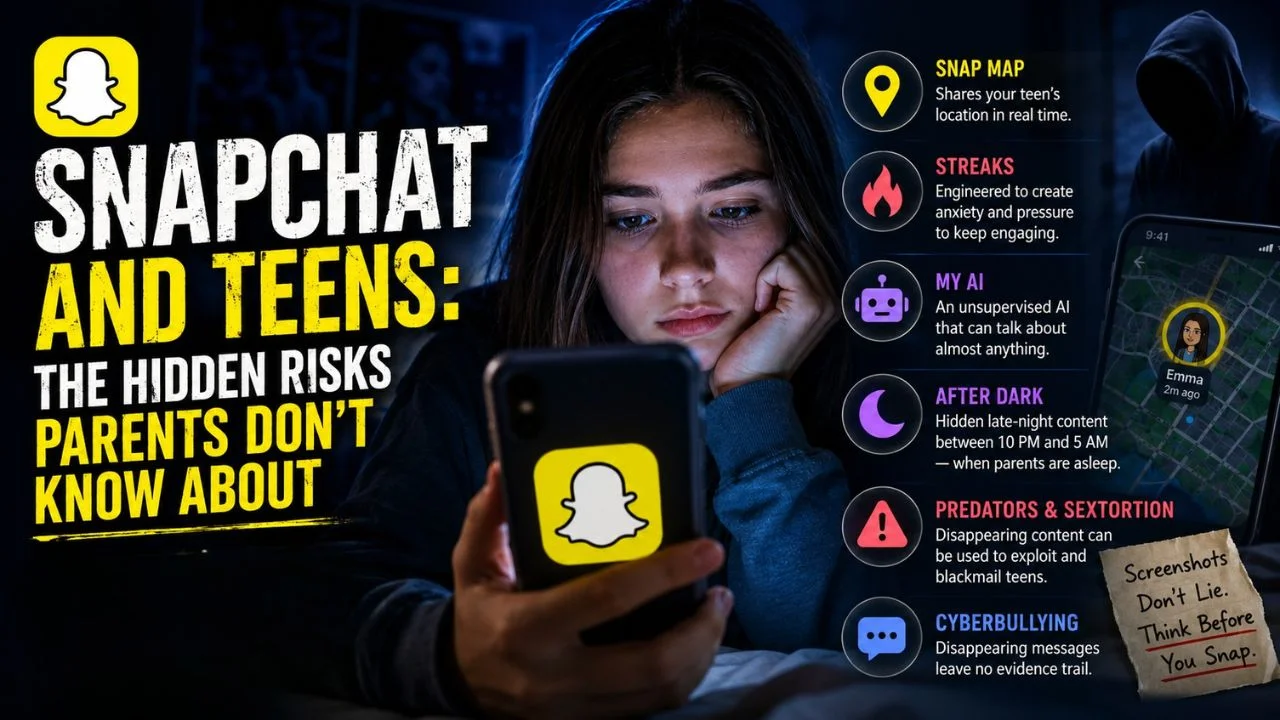
- Snap Map — real-time location sharing with your friends list
- Spotlight — a TikTok-style public video feed
- Discover — content from media publishers and creators
- My AI — a built-in AI chatbot powered by ChatGPT
- Streaks — a consecutive-day messaging counter that creates pressure to keep chatting daily
- After Dark — a feature for Stories visible only between 10 PM and 5 AM
Snapchat’s minimum age is 13. There is no meaningful age verification — a child can enter any birth date and gain full access.
The Hidden Risks — What Parents Miss
1. Disappearing Messages Create a False Sense of Safety
This is the central design risk of Snapchat and the one that underpins almost every other danger on this list. Teenagers — and many parents — believe that because Snaps disappear, they are gone. They are not.
Snaps can be screenshotted or recorded by another device. Snapchat notifies the sender of a screenshot — but only within the app, and only if the screenshot was taken through Snapchat itself. A second phone photographing the screen leaves no trace whatsoever.
This false sense of privacy leads teenagers to share content they would never post publicly on Instagram — and that content can resurface months or years later.
2. Snap Map — Your Teen’s Location, Live
Snap Map shows a user’s real-time location to everyone on their friends list. Location sharing is off by default — but many teens turn it on without understanding what they’ve enabled.
When active, Snap Map broadcasts where your teenager is right now, in real time, to every person they have added as a friend on Snapchat — including people they may have added casually, or strangers who connected through mutual friends. This setting should always be set to Ghost Mode for all users under 18. Check it. Do not assume it is off.
3. Streaks — Engineered Anxiety
Streaks — the consecutive number of days two users have exchanged Snaps — can create real pressure for continuous engagement, leading to anxiety, excessive screen time, and fear of missing out.
This is not a side effect of the feature. It is the feature’s purpose. Streaks are designed to make opening Snapchat every single day feel obligatory. Teenagers have reported genuine distress at losing a streak — and some check the app last thing at night and first thing in the morning specifically to maintain them. This is a deliberate engagement mechanic dressed as a social connection feature.
4. My AI — An Unsupervised Adult Conversation Partner
Snapchat’s built-in AI chatbot, My AI, is available to all users, including those under 13. It appears at the top of the chat list, pinned, and cannot be removed on standard accounts. It can discuss almost any topic.
Family Center allows parents to disable My AI — but this requires parents to know it exists and to actively turn it off. Most do not. An AI that will discuss relationships, sexuality, substances, and personal secrets with a 13-year-old — without a parent knowing — is a risk worth taking seriously.
5. After Dark — Hidden From Parents by Design
After Dark is a Snapchat Stories feature that activates between 10 PM and 5 AM. Stories posted during this window are only visible during those hours — creating a late-night social environment that is specifically structured to happen after parents are asleep. Content on After Dark is not additionally moderated beyond standard Snapchat guidelines, meaning it carries the same risks as the rest of the platform but in a time window where parental oversight is lowest.
6. Predatory Contact and Sextortion
Snapchat’s disappearing content makes it a documented platform for sextortion — predators obtain or pressure teens into sending explicit content, then use the threat of exposure as leverage for money or more images. The ephemeral design that makes the platform feel safe is exactly what makes it appealing for this kind of exploitation.
In its January to June 2025 transparency report, Snapchat reported acting on over 700,000 cyberbullying and harassment cases — but notes that making a new account after a ban is easy, making comprehensive moderation impossible at scale.
For a full picture of how online predators operate across all platforms, see our guide on online predators in 2026: how they find children and how to protect yours.
7. Cyberbullying With No Evidence Trail
Because messages disappear, bullying on Snapchat leaves no lasting evidence trail — which makes it harder for schools, parents, and law enforcement to document and address. A teenager being bullied via Snapchat may struggle to prove it ever happened, and may be reluctant to report it, knowing there is little they can capture as proof.
What Snapchat Has Improved
To be fair, Snapchat has introduced meaningful safety features in 2024–2025:
- Teen accounts (13–17) do not appear in search results unless there are mutual friends or the searcher is a phone contact
- Teens can only receive messages from users they have added, with a caution prompt displayed if a teen tries to message an adult who is not a friend
- Family Center — parents can link accounts, see friend lists, view who their teen has chatted with in the past week (not content), restrict sensitive content, disable My AI, and request location visibility
- Travel alerts can notify parents when a teen arrives or leaves certain locations
- Australia compliance — from December 2025, Snapchat locked or limited accounts for Australian users who could not confirm they meet the under-16 restriction
These are real improvements. The core design risks — disappearing content, streaks, Snap Map, and After Dark — remain.
What Age Is Snapchat App Appropriate For?
| Age | Verdict | Guidance |
|---|---|---|
| Under 13 | Not appropriate | Against Snapchat’s own Terms of Service |
| 13–14 | Not recommended | Too many unmonitored risks for this age group |
| 15–16 | Caution required | Ghost Mode on, Family Center active, no streaks pressure |
| 17+ | Appropriate with awareness | Ongoing conversation about privacy and content |
6 Steps to Set Up Snapchat Safely Right Now
1. Enable Ghost Mode immediately — Snap Map > Settings > Ghost Mode. Do this before anything else.
2. Set up Family Center — Go to your own Snapchat account, search Family Center in settings, and send your teen an invite. This gives you visibility into friend lists and chat contacts without reading messages.
3. Disable My AI — In Family Center, turn off My AI. Your teen does not need an unsupervised AI chatbot.
4. Check Story privacy — Go to your teen’s Settings > Privacy Controls > View My Story — ensure it is set to Friends only, not Everyone.
5. Talk about streaks — Have an explicit conversation about streaks: missing one is fine, losing a streak is not an emergency, and no app should dictate when they must open their phone.
6. Know about After Dark — Tell your teen you know about it. That alone reduces the risk significantly.
The Bottom Line
Snapchat’s greatest danger is not the content on the platform — it is the design of the platform itself. Disappearing messages, real-time location, engineered daily pressure through streaks, a late-night Stories mode, and an AI chatbot that parents rarely know about — none of these are accidents. They are deliberate features that create engagement and, in the process, create risk.
The improvements Snapchat has made in Family Center and teen account defaults are real — but they require parents to actively set them up. Most do not. That gap between what is available and what is actually configured is where most of the harm happens.
If your teenager uses Snapchat, spend 20 minutes this week going through the settings together. Ghost Mode on. Family Center linked. My AI off. Story privacy checked. Those four things alone close the biggest gaps.
For context on the broader social media mental health picture, read our guide on how social media changes the teenage brain — what neuroscience says.
References
- Jonathan Haidt / After Babel (April 2025). Snapchat Is Harming Children at an Industrial Scale. afterbabel.com
- Snapchat Family Center & Teen Safeguards: parents.snapchat.com
- Snapchat Transparency Report H1 2025: snap.com/en-US/privacy/transparency
- Children of the Digital Age — Snapchat Safety Settings 2025: childrenofthedigitalage.org
- Safety Detectives — Is Snapchat Safe for Kids 2026: safetydetectives.com
- Kinzoo — Parent’s Guide to Snapchat 2025: kinzoo.com/blog