
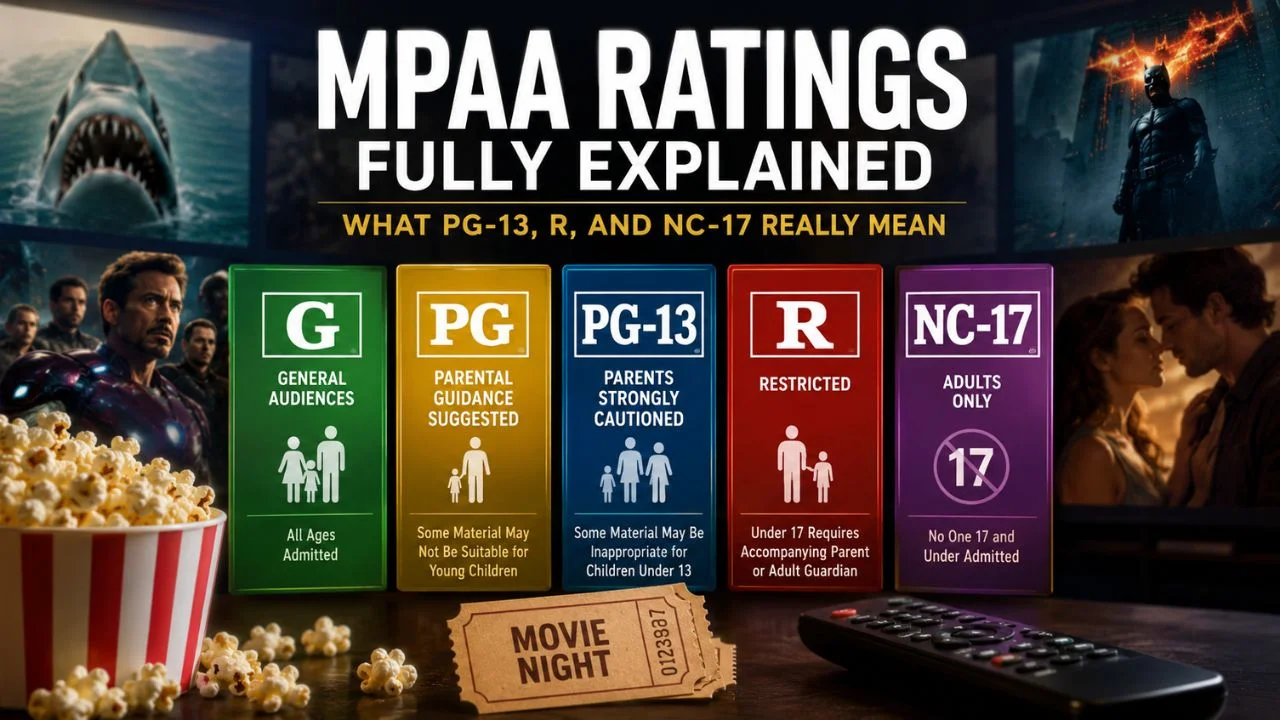
You have seen them thousands of times. The small rectangular block in the corner of a movie poster or the opening seconds of a trailer: G. PG. PG-13. R. NC-17. Most people know roughly what they mean. Very few understand how they actually work, why they exist, who decides them, and — most importantly for parents — what those letters actually guarantee about a film’s content.
The answer to that last question might surprise you.
A Brief History: How the Rating System Was Born
The MPAA rating system did not always exist. For nearly the first half of Hollywood’s history, the industry was governed by something far more restrictive: the Hays Code, a strict self-censorship framework introduced in the 1930s under conservative Presbyterian minister Will H. Hays. The Code dictated that crime must never pay, that no sexual content could be shown, and that moral order must always be restored by a film’s end.
By the 1960s, the Hays Code was creaking under the weight of social change. Jack Valenti, the newly appointed president of the MPAA, hated it — he saw it as dated, censorious, and fundamentally at odds with artistic freedom.
In 1968, Valenti replaced the Hays Code with a wholly voluntary letter-based ratings system — first put into effect with the ratings G, M (later PG), R, and X. The system was designed not to censor content but to inform audiences, allowing parents to make their own decisions. It was a fundamental philosophical shift: from prohibition to information.
The system has been updated several times since — most notably in 1984 and 1990 — and remains in use today under the Classification and Rating Administration (CARA), a division of the Motion Picture Association (MPA, as it was renamed in 2019).
Who Actually Decides the Rating?
This is the part most people never think about — and it is genuinely interesting.
The CARA rating board is made up of a chairperson, a vice-chair, and several senior raters. In addition, a group of nine parents from diverse backgrounds — big cities, small towns, different ethnicities, different regions of the United States — with no connection to the film industry are chosen to represent the average American parent.
These parent raters watch each film and vote on what rating best reflects how American parents broadly would view the content. The rating is based on majority vote. There is no algorithm, no checklist that automatically determines the outcome — it is a human judgement process, which is exactly why two films with similar content can sometimes receive different ratings, and why the system is periodically criticized as inconsistent.
Studios can appeal a rating they disagree with. They can also choose to re-edit a film to achieve a lower rating — something that happens regularly when a director’s cut earns an NC-17 and the studio wants an R.
Every Rating — Fully Explained
G — General Audiences
What it means: Nothing in the film would offend parents whose younger children view it. No nudity, no sex, no drug use, no strong language. Violence, if present at all, is minimal and consequence-free in tone.
What it does not mean: That it is only for young children, or that adults will find it boring. Some of the most beloved films ever made — from classic Disney animations to certain Pixar films — carry G ratings.
Parent note: A G rating is genuinely the most reliable rating in the system. It is also the rarest for mainstream theatrical releases.
PG — Parental Guidance Suggested
What it means: Some material may not be suitable for young children. Parents are urged to investigate before allowing their younger children to attend.
What it actually allows: Mild language (no strong profanity), brief nudity (no sexual context), some violence (not intense or graphic), and thematic elements that may be too mature for young children.
Parent note: PG is where the gap between the rating and reality most commonly surprises parents. Films like Jaws in the 1970s — with violence, intense threat, and adult themes — received PG ratings. The standard has tightened since, but PG films can still contain content that parents of very young children (under 7) may find inappropriate. Always check the specific content descriptors beneath the rating, not just the letter.
PG-13 — Parents Strongly Cautioned
What it means: Some material may be inappropriate for children under 13. Parents are strongly cautioned to give special consideration before allowing their under-13 children to attend.
How it was created: The PG-13 rating was created in 1984 at the direct suggestion of Steven Spielberg, following parental outcry over the PG-rated Indiana Jones and the Temple of Doom and Gremlins — both of which contained content many parents felt was too intense for a standard PG. Spielberg called Jack Valenti and proposed a middle ground. Red Dawn (1984) became the first film released with the PG-13 rating.
What it actually allows:
- Violence that is intense but not graphically gory
- Brief nudity — though sexual nudity typically pushes a film to R
- Drug and alcohol use — depicted but not glorified
- A single use of a strong expletive (specifically, a sexual use of a particular profanity) — more than one typically triggers an R
- Thematic elements including death, peril, and moral complexity
The PG-13 paradox: PG-13 is the most commercially valuable rating in Hollywood because it reaches the widest possible audience — teens, adults, and supervised children. This commercial incentive has led to persistent criticism that studios push content to the edge of the rating to maximize their audience, and that the MPAA is lenient with violence but strict with sexuality — a value judgment many find inconsistent.
The Dark Knight, Avengers: Endgame, and the entire Marvel Cinematic Universe carry PG-13 ratings despite containing sustained, intense violence. A brief moment of non-sexual nudity can push an otherwise mild film to R.
Parent note: Do not rely on PG-13 as synonymous with “fine for my 10-year-old.” Some PG-13 films are genuinely appropriate for younger teens. Others — particularly in the action and thriller categories — contain content that many parents would prefer their children not see until they are older. The content descriptors tell you far more than the rating alone.
R — Restricted
What it means: Under 17 requires accompanying parent or adult guardian. The film contains adult material.
What it actually allows: Strong language (including frequent strong profanity), graphic violence, nudity, sexual content (not explicit), drug use, and adult themes. The R rating is the broadest category in the system — a mild R and a hard R can feel like entirely different films.
The R range is enormous: A film earning R for “brief strong language” is in the same category as a film earning R for “graphic violence, strong sexual content, and pervasive drug use.” This is why content descriptors exist — the letter alone tells you far less than it appears to.
Parent note: Cinema staff are required to enforce the R rating for unaccompanied minors — no one under 17 can purchase a ticket without a parent or adult guardian. On streaming, this enforcement is absent. Set up profile restrictions and maturity ratings on your streaming platforms to enforce this digitally.
For a platform-by-platform guide to enforcing age restrictions on streaming services, see our article on how to check what your child is watching on Netflix.
NC-17 — Adults Only
What it means: No one 17 and under is admitted. Period. No exceptions, no guardian override.
How it came to be: The NC-17 rating replaced the X rating in 1990. The X rating had become commercially toxic because the pornography industry had unofficially adopted it — a self-assigned label that gave X-rated theatrical films the same stigma as pornography. NC-17 was created to give serious adult films a designation that separated them from pornography while maintaining the restriction.
The problem with NC-17: NC-17 is widely considered the “kiss of death” for a film. Many major theater chains refuse to screen NC-17 films. Most streaming services will not carry them. Mainstream advertising is largely unavailable. This commercial reality means that most filmmakers and studios re-edit films until they achieve an R rating — sometimes multiple times — rather than accept NC-17.
The result is a rating that theoretically protects the space for serious adult filmmaking, but in practice is commercially devastating and therefore rarely used.
What NC-17 actually flags: Explicit sexual activity. Extreme graphic violence. Graphic nudity in a clearly sexual context. Content that is not pornographic but goes further than anything an R-rated film would contain.
Parent note: You are unlikely to encounter NC-17 content on mainstream streaming services. If you do, treat it as you would an 18-rated film in the UK or an MA 15+ in Australia — strictly adult content.
The Content Descriptors
Since 1990, every PG, PG-13, R, and NC-17 rating has been accompanied by content descriptors — the small text beneath the rating that explains what earned it. These descriptors are tailored for every individual film and tell parents specifically what type of content the film contains.
| Descriptor | What It Means |
|---|---|
| Mild violence | Action without intense detail or consequence — PG level |
| Intense sequences of action | Sustained combat or threat — common PG-13 |
| Strong bloody violence | Graphic injury detail — typically R |
| Brief language | A small number of strong words — may appear at PG-13 |
| Pervasive language | Strong profanity throughout — R |
| Sexual references | Dialogue or suggestion without depiction — PG-13 |
| Nudity | Non-sexual nudity — can appear at PG-13 or R |
| Strong sexual content | Detailed depiction without full explicitness — R |
| Drug use | Depicted use of illegal substances |
| Thematic elements | Mature themes not falling into specific categories |
The most practical advice for parents: Always read the descriptors, not just the rating. Two films can carry identical ratings and contain completely different types of content. A film rated R for “pervasive language” is a very different viewing experience from one rated R for “graphic violence and drug use.”
The Honest Criticisms of the System
No guide to MPAA ratings is complete without acknowledging the system’s genuine limitations:
Violence is treated more leniently than sex. This is the most consistent and well-documented criticism. Films can depict extensive combat, death, and human suffering at the PG-13 level — but brief non-sexual nudity often earns an R. Many child development experts argue this sends a harmful cultural message.
The system is voluntary. No law requires studios to submit films for rating. Unrated films can be distributed freely — though most major theater chains and streaming platforms require ratings for mainstream releases.
It is inconsistent. Because ratings are decided by a small panel of parents using subjective judgment, similar content can receive different ratings across films. The system has been criticized for favoring big studio releases over independent films in close calls.
It does not cover streaming. The MPAA system applies to theatrical releases and physical media. Streaming platforms apply the TV Parental Guidelines for TV content and either adopt MPAA ratings for films or apply their own internal ratings for original productions. A Netflix original film carries a Netflix-applied rating, not necessarily one reviewed by CARA.
Quick Reference: All Five Ratings at a Glance
| Rating | Who Can Watch | Key Content Allowed | Most Common Genre |
|---|---|---|---|
| G | Everyone | Minimal conflict, no mature themes | Animated family films |
| PG | All ages — parents advised | Mild language, mild violence, brief nudity | Family adventure, comedy |
| PG-13 | Under 13 with parental guidance | Intense violence, mild sexuality, limited profanity | Action, superhero, thriller |
| R | 17+ or with parent/guardian | Strong language, graphic violence, sexual content | Drama, horror, crime |
| NC-17 | 17+ only — no exceptions | Explicit sexual content, extreme violence | Adult drama |
The Bottom Line for Parents
MPAA ratings are a useful starting point — not a final verdict. They tell you the level of content a panel of American parents judged appropriate for various audiences. They do not tell you whether a specific film is right for your specific child, who may be more sensitive to certain content types, younger or older than the rating threshold, or watching in a context that makes certain content more or less impactful.
The most valuable thing the system gives you is the content descriptors. Use them. A G rating with no caveats is about as reliable a guarantee as the system offers. A PG-13 for “intense sequences of violence and thematic elements” is a much more nuanced signal that merits five minutes of research before your 11-year-old watches it.
The rating is the beginning of the conversation — not the end of it.
For a comparison of how the MPAA system compares to the UK’s BBFC and India’s CBFC, read our full breakdown: why age ratings differ between countries — US vs UK vs India.